Electric cars work by storing electrical energy in a large battery pack and sending that energy to one or more electric motors. The motors turn the wheels, moving the car without burning petrol or diesel.
When the driver presses the accelerator, electronic controls calculate how much power the motor needs. Electricity travels from the battery through an inverter and power-control system before reaching the motor. The motor then converts electrical energy into mechanical movement.
When the driver slows down, the process can work in reverse. The wheels turn the motor, which acts as a generator and returns some energy to the battery through regenerative braking.
A fully electric car uses a rechargeable traction battery to power an electric motor. The motor sends torque to the wheels through a simple reduction gear. An inverter controls the electricity supplied to the motor, while regenerative braking recovers part of the car’s movement energy when it slows down.
How an Electric Car Works
The working process of a battery-electric car can be reduced to five stages:
- Electricity is stored in the high-voltage traction battery.
- The driver presses the accelerator pedal.
- The power electronics controller tells the inverter how much electricity to send to the motor.
- The electric motor converts that electricity into rotational force.
- The drivetrain transfers the motor’s rotation to the wheels.
When the driver releases the accelerator or presses the brake pedal, the motor can reverse its role. Instead of consuming electricity, it generates electricity from the movement of the wheels and returns some of it to the battery.
Electric car energy flow
During acceleration:
Battery → inverter → electric motor → reduction gear → wheels
During regenerative braking:
Wheels → electric motor/generator → inverter → battery
The process is managed electronically and happens almost instantly, which is why electric cars can respond quickly when the accelerator is pressed.
What Is a Battery-Electric Car?
A battery-electric vehicle, or BEV, is powered entirely by electricity stored in a rechargeable battery.
It does not have:
- A petrol or diesel engine
- A fuel tank
- Spark plugs
- A conventional exhaust system
- Engine oil
- A multi-speed manual gearbox
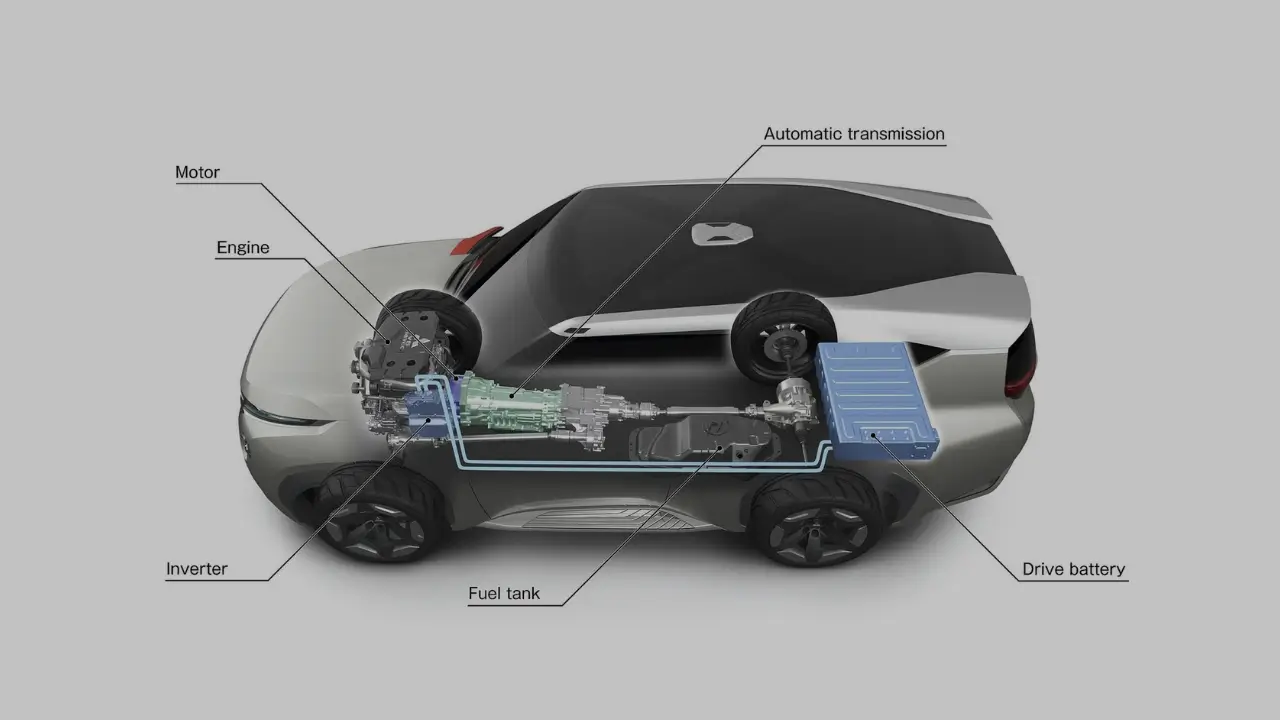
Instead, a BEV uses a traction battery, electric motor, inverter, charging hardware, electronic control systems and a compact drivetrain.
Examples include the Tesla Model 3, Tesla Model Y, Hyundai Ioniq 5, Kia EV6 and Nissan Leaf.
Battery-electric cars should not be confused with conventional hybrids or plug-in hybrids. Those vehicles still have an internal combustion engine.
For a direct comparison, read our guide to electric, hybrid and plug-in hybrid cars.
Main Components of an Electric Car
Although electric cars contain advanced electronics, their propulsion systems generally have fewer mechanical parts than combustion-engine drivetrains.
| Component | Main function |
| Traction battery | Stores high-voltage electricity |
| Electric traction motor | Converts electricity into wheel movement |
| Inverter | Changes direct current into alternating current and controls motor operation |
| Power electronics controller | Manages power flow, motor speed and torque |
| Reduction gear | Transfers motor rotation to the wheels |
| Charge port | Connects the car to charging equipment |
| Onboard charger | Converts incoming AC electricity into DC for the battery |
| DC-to-DC converter | Reduces high voltage to power low-voltage systems |
| 12-volt battery | Powers lights, computers, locks and control systems |
| Thermal-management system | Controls battery, motor and electronics temperature |
| Battery management system | Monitors battery cells, temperature, voltage and charge |
| Regenerative braking system | Recovers energy while the car slows down |
1. Traction Battery Pack
The traction battery is the main energy-storage unit in an electric car. It is much larger and more powerful than a normal 12-volt car battery.
Most modern electric cars use lithium-ion battery cells grouped into modules and assembled into a complete pack. Depending on the vehicle, the pack may be installed beneath the passenger compartment, through the centre of the chassis or around other structural areas.
Installing the battery low in the vehicle can lower the centre of gravity. This can help stability and reduce body movement when cornering, although total handling also depends on suspension, tyres, weight distribution and vehicle design.
Battery capacity
Electric car battery capacity is usually measured in kilowatt-hours, written as kWh.
A larger kWh figure generally means the battery can store more energy. However, battery capacity alone does not determine range.
Driving range is also affected by:
- Vehicle weight
- Motor efficiency
- Aerodynamics
- Tyre size and pressure
- Driving speed
- Outside temperature
- Cabin heating or air conditioning
- Road gradient
- Passenger and cargo load
- Battery condition
For example, two vehicles with the same battery capacity may deliver different ranges because one uses energy more efficiently.
Our guide to electric car battery capacity and range explains how kWh relates to real-world driving distance.
Usable and total battery capacity
Manufacturers may publish either total battery capacity or usable battery capacity.
Total capacity represents all the energy the pack can theoretically hold. Usable capacity is the portion made available to the driver.
The battery-management system normally reserves some capacity at the top and bottom of the charge range. This buffer helps protect the battery from extreme charge and discharge conditions.
2. Electric Traction Motor
The electric motor converts electrical energy into mechanical rotation.
Inside the motor, magnetic fields create force between stationary and rotating components. That force turns the motor shaft, which transfers torque through the reduction gear to the wheels.
Unlike an internal combustion engine, an electric motor does not need to burn fuel through repeated explosions. It can begin producing useful torque as soon as electrical power is supplied.
Why electric cars accelerate quickly
Many electric motors can provide strong torque from very low speeds. This gives electric cars an immediate response when the accelerator is pressed.
A petrol engine usually needs to build engine speed before reaching peak torque. It may also need to change gears to stay within its most effective operating range.
An electric motor can operate across a much broader speed range, allowing many EVs to use a single-speed transmission.
Fast acceleration is not guaranteed in every electric car. Performance still depends on:
- Motor output
- Vehicle weight
- Battery power
- Traction
- Software settings
- Drive configuration
Some EVs are tuned for efficiency and urban use rather than maximum performance.
3. Inverter
An electric car battery stores direct-current electricity, or DC. Many electric traction motors use alternating current, or AC.
The inverter converts DC electricity from the battery into the form required by the motor.
It also controls the frequency and strength of the electrical current, helping regulate motor speed and torque.
During regenerative braking, the inverter handles the reverse energy flow. Electricity generated by the motor must be converted into a form that can be stored in the battery.
The inverter is therefore one of the most important links between the battery and the motor.
4. Power Electronics Controller
The power electronics controller manages the flow of electrical energy from the traction battery.
When the driver presses the accelerator, sensors detect the pedal position. The controller calculates how much torque is being requested and regulates the power supplied to the motor.
This system communicates with other vehicle computers to consider factors such as:
- Wheel speed
- Traction-control activity
- Battery charge
- Battery temperature
- Selected driving mode
- Motor temperature
- Stability-control input
The controller can limit output when necessary to protect the battery, motor or drivetrain.
For example, maximum performance may be reduced when the battery is extremely cold, very hot or close to empty.
5. Reduction Gear and Electric Drivetrain
Most electric cars do not need the type of multi-speed transmission found in petrol and diesel vehicles.
Instead, many use a single-speed reduction gear.
The motor can rotate at very high speeds. The reduction gear lowers that speed and increases usable torque before sending power to the wheels.
This setup can provide:
- Smooth acceleration
- No conventional gear changes
- Fewer mechanical drivetrain components
- Direct power delivery
- Less drivetrain vibration
Some performance-focused EVs use two-speed transmissions, but these remain less common than single-speed systems.
Front-, rear- and all-wheel drive
An EV can be designed with different motor layouts.
Front-wheel-drive EV:
A motor drives the front wheels.
Rear-wheel-drive EV:
A motor drives the rear wheels.
All-wheel-drive EV:
Separate motors may drive the front and rear axles.
Dual-motor and multi-motor layouts can distribute power electronically. This allows the vehicle to adjust torque between the axles without a traditional mechanical connection running the full length of the car.
6. Battery Management System
The battery management system, commonly called the BMS, monitors and controls the traction battery.
It tracks factors such as:
- Cell voltage
- Battery temperature
- Charge level
- Charging current
- Discharging current
- Cell balance
- Estimated battery health
A battery pack contains many individual cells. Small differences can develop between them over time. The BMS helps keep the cells operating within safe limits and may balance their charge levels.
The system can also reduce charging or driving power when temperatures or voltages move outside the desired range.
This protection is important because battery cells can be damaged by excessive heat, deep discharge, overcharging or unsuitable charging rates.
7. Thermal-Management System
Electric car batteries, motors and power electronics operate most effectively within suitable temperature ranges.
The thermal-management system controls their temperature using air, liquid coolant, refrigerant or a combination of methods.
It may cool components during:
- Rapid acceleration
- High-speed driving
- Hot weather
- DC fast charging
- Heavy towing
- Repeated performance driving
It may also warm the battery before driving or charging in cold conditions.
Battery preconditioning
Some EVs can precondition the battery before reaching a fast charger.
The car may use route information from its navigation system to warm or cool the battery to a suitable charging temperature. This can help the vehicle accept higher charging power sooner.
Not every electric car has the same thermal-management design. Some early or lower-cost models may use simpler air-cooled systems, while many newer EVs use liquid cooling.
8. The 12-Volt Battery
Electric cars normally have a small 12-volt battery in addition to the high-voltage traction battery.
The 12-volt battery powers low-voltage equipment such as:
- Door locks
- Interior lights
- Exterior lights
- Infotainment systems
- Safety controllers
- Alarm systems
- Vehicle computers
- Electronic switches
It also helps activate the high-voltage system when the vehicle is started.
An electric car may have plenty of energy in its traction battery but still fail to start if the 12-volt battery is discharged or faulty.
9. DC-to-DC Converter
A combustion car uses an alternator to recharge its 12-volt battery while the engine runs.
An electric car does not have a conventional engine-driven alternator. Instead, it uses a DC-to-DC converter.
The converter reduces high-voltage electricity from the traction battery to a lower voltage suitable for the 12-volt battery and low-voltage accessories.
It performs a similar practical role to an alternator but does so electronically.
What Happens When You Start an Electric Car?
Starting an electric car is different from starting a petrol or diesel vehicle.
There is no starter motor cranking an engine and no fuel being ignited.
When the driver presses the start button or activates the car:
- The low-voltage system checks key vehicle functions.
- The high-voltage battery is connected to the drivetrain.
- Control systems confirm that the vehicle is ready.
- The dashboard displays a ready indicator.
- Power becomes available when the driver selects a direction and presses the accelerator.
Because the motor is not idling, the car may remain almost silent while stationary.
Drivers should rely on the dashboard’s ready light rather than engine noise to determine whether the vehicle is switched on.
What Happens When You Press the Accelerator?
An EV accelerator pedal does not mechanically open a throttle in the way older combustion vehicles did.
Instead, it sends an electronic request to the vehicle’s control systems.
The process works like this:
- A sensor measures how far the pedal is pressed.
- The control system calculates the requested torque.
- The inverter regulates electricity from the battery.
- The motor creates rotational force.
- The reduction gear transfers that force to the wheels.
The response can happen very quickly because the motor does not need to wait for combustion, clutch engagement or a conventional gear change.
Driving modes can change this response. An Eco mode may soften acceleration and reduce climate-control demand, while a Sport mode may provide faster pedal response and greater power availability.
How Regenerative Braking Works
Regenerative braking allows an electric car to recover part of the energy that would otherwise be lost as heat during braking.
When the driver releases the accelerator or presses the brake pedal, the wheels continue turning because the vehicle is moving.
Instead of using electricity to turn the wheels, the motor is driven by the wheels. It operates as a generator and produces electrical energy.
That electricity passes through the power electronics and is returned to the battery.
Regenerative braking energy flow
Moving wheels → motor acting as generator → inverter → battery
The generation process creates resistance at the motor, which helps slow the car.
Does regenerative braking replace normal brakes?
No. Electric cars still have conventional friction brakes.
The brake-control system blends regenerative braking with the wheel-mounted friction brakes. Friction braking may be needed when:
- The driver brakes heavily
- The vehicle is moving very slowly
- The battery is full
- The battery is too cold or hot
- Regenerative braking is limited
- Emergency braking is required
- Stability-control systems intervene
Regenerative braking can reduce the use of brake pads and discs, but it does not remove the need to inspect and maintain them.
One-pedal driving
Some electric cars offer one-pedal driving.
In this mode, releasing the accelerator creates strong regenerative braking. The vehicle may slow to a complete stop without the driver pressing the brake pedal during normal driving.
The brake pedal remains available and should be used whenever additional stopping force is needed.
Regenerative-braking strength and one-pedal operation vary by model. Some cars allow the driver to select different levels through dashboard settings or steering-wheel paddles.
How Electric Cars Charge
Electric cars receive energy through a charge port connected to external charging equipment.
The charging process depends on whether the car receives alternating current or direct current.
AC charging
Homes and many public charging stations supply AC electricity.
The car’s onboard charger converts incoming AC electricity into DC electricity that can be stored in the traction battery.
The charging path is:
Electricity supply → charging equipment → charge port → onboard charger → battery
The onboard charger limits the AC charging rate. Connecting a car to a charger with a higher power rating will not make the car exceed its own onboard AC limit.
DC fast charging
DC fast chargers convert electricity outside the car and send direct current toward the battery.
This allows them to bypass much of the vehicle’s onboard AC charging hardware and supply energy at a higher rate.
The path is:
Electricity supply → external DC charger → charge port → battery
The vehicle still controls how much power the battery accepts.
Charging speed depends on:
- Charger output
- Vehicle charging limit
- Battery temperature
- Battery charge level
- Battery condition
- Charging-station load
- Thermal-management performance
The maximum advertised charging rate is usually a peak figure rather than a rate maintained throughout the whole session.
Why charging slows near full
Electric car charging usually slows as the battery approaches a high state of charge.
The battery-management system reduces charging power to control heat and protect the cells.
For this reason, charging from 80% to 100% may take disproportionately longer than charging through the middle of the battery’s range.
Drivers taking long journeys often save time by charging enough to reach the next suitable stop rather than waiting for 100% at every rapid charger.
Read our complete EV charging guide for connector types, charging speeds and home-installation considerations.
How Does an Electric Car Know How Much Range Is Left?
An electric car estimates remaining range using information from the battery and recent vehicle operation.
The estimate may consider:
- Current battery charge
- Recent energy consumption
- Driving speed
- Outside temperature
- Climate-control use
- Route elevation
- Traffic conditions
- Driving mode
- Historical driving behaviour
This displayed estimate is sometimes called a range estimator or “guess-o-meter” because it can change as conditions change.
For example, projected range may fall after sustained high-speed motorway driving or rise after efficient urban driving.
The battery percentage is often a more stable reference than the predicted distance, although drivers should consider both.
Why Electric Cars Are More Energy Efficient
A petrol or diesel engine loses a large amount of energy through heat, exhaust gases, friction and auxiliary systems.
An electric motor converts a larger share of stored energy into movement. It also does not consume energy by idling in the same way as a combustion engine.
Regenerative braking adds another advantage by recovering some energy during deceleration.
Real-world efficiency still changes with:
- Vehicle size
- Speed
- Weather
- Tyres
- Aerodynamics
- Heating and cooling
- Driving style
- Road conditions
A large, heavy electric SUV will generally consume more electricity than a smaller, lighter electric hatchback.
Electric car efficiency is commonly shown as:
- kWh per 100 kilometres
- Miles per kWh
- MPGe in the United States
- Wh per kilometre
Lower kWh/100 km and higher miles/kWh indicate better energy efficiency.
Do Electric Cars Have Engines?
Fully electric cars do not have internal combustion engines.
They have one or more electric motors.
The words “engine” and “motor” are sometimes used interchangeably in ordinary conversation, but they refer to different systems in this context.
An engine produces mechanical power by burning fuel. An electric motor produces mechanical power from electricity and magnetic fields.
Plug-in hybrids and conventional hybrids have both an engine and one or more electric motors.
Do Electric Cars Have Gears?
Most electric cars have gears inside their reduction-drive units, but they do not usually have multiple driver-selected forward gears.
A typical EV uses a fixed gear ratio between the electric motor and the wheels.
This is possible because an electric motor can operate effectively across a wide speed range.
The driver usually selects:
- Park
- Reverse
- Neutral
- Drive
Some EVs also provide a stronger regenerative-braking position or adjustable regeneration settings.
Do Electric Cars Make Noise?
Electric motors are much quieter than combustion engines, especially at low speeds.
Drivers may still hear:
- Tyre noise
- Wind noise
- Motor whine
- Cooling pumps
- Air-conditioning systems
- Suspension movement
- Artificial pedestrian-warning sounds
Many electric vehicles produce an external warning sound at low speeds to help pedestrians detect the vehicle.
At higher speeds, tyre and wind noise often become the main sources of sound, regardless of powertrain type.
What Happens When an Electric Car Battery Runs Out?
As an electric car approaches a very low charge level, it normally issues repeated warnings.
The vehicle may:
- Display a low-battery warning.
- suggest nearby charging stations.
- reduce available power.
- enter a limited-performance mode.
- stop when the usable battery reserve is exhausted.
The exact behaviour differs by vehicle.
An EV with a depleted traction battery normally needs roadside charging or transport to a charging location. It should not be towed with its driven wheels on the road unless the manufacturer specifically permits that towing method.
Repeatedly running the battery to its lowest possible level is generally not good ownership practice.
How Electric Cars Work in Cold Weather
Cold temperatures can reduce an EV’s available range and charging speed.
Several factors contribute:
- Battery chemical reactions slow down.
- The battery may use energy to warm itself.
- Cabin heating consumes electricity.
- Cold air can increase aerodynamic resistance.
- Tyre pressure may fall.
- Regenerative braking may initially be limited.
An EV may use battery preconditioning to improve performance before driving or fast charging.
Preheating the cabin while the car is plugged in can also reduce how much stored battery energy is used at the beginning of a trip.
The effect of cold weather differs between vehicles because battery chemistry, heat-pump availability, insulation and thermal-management systems vary.
How Electric Cars Work in Hot Weather
High temperatures can also affect electric cars.
The thermal-management system may use energy to cool the battery, cabin and power electronics.
Extreme heat may reduce charging speed if the system needs to protect the battery. Parking in shade and using scheduled cabin cooling while connected to a charger may improve comfort without drawing as much energy from the battery after departure.
Modern battery systems monitor temperature closely and can limit charging or motor output when needed.
Electric Cars vs Petrol Cars
| Feature | Electric car | Petrol or diesel car |
| Energy source | Electricity | Petrol or diesel |
| Main propulsion unit | Electric motor | Combustion engine |
| Energy storage | Traction battery | Fuel tank |
| Gearbox | Usually single-speed | Usually multi-speed |
| Tailpipe | None on a BEV | Required |
| Engine oil | Not required | Required |
| Idling fuel use | No motor energy use when stationary | Engine may keep running |
| Braking energy | Partly recovered | Mostly lost as heat |
| Refuelling or charging | Charging connection | Fuel pump |
| Routine drivetrain maintenance | Generally fewer items | More fluids and moving components |
A combustion car stores energy chemically in liquid fuel. The engine burns that fuel to produce heat and pressure, which move pistons and turn a crankshaft.
An electric car stores energy electrochemically in a battery. The motor converts electricity directly into rotation.
This difference explains why EV drivetrains can be quieter, mechanically simpler and more responsive.
Electric Cars vs Hybrid Cars
A conventional hybrid combines a combustion engine, electric motor and small battery.
It does not normally need to be plugged in. The battery is charged through the engine and regenerative braking.
A plug-in hybrid has a larger battery that can be charged externally. It can travel a limited distance using electricity before relying more heavily on its engine.
A battery-electric car has no combustion engine and must receive its main energy through external charging.
| Vehicle type | Plugs in | Has an engine | Can drive on electricity alone |
| Battery-electric vehicle | Yes | No | Yes |
| Plug-in hybrid | Yes | Yes | Yes, for a limited range |
| Conventional hybrid | No | Yes | Usually for short, low-power periods |
| Petrol or diesel car | No | Yes | No |
Are Electric Cars Easier to Maintain?
Electric drivetrains generally have fewer routine maintenance requirements than petrol or diesel powertrains.
A BEV does not need:
- Engine-oil changes
- Spark-plug replacement
- Exhaust-system repairs
- Fuel-filter replacement
- Timing-belt replacement
- Conventional engine servicing
However, electric cars still need maintenance.
Owners must monitor:
- Tyres
- Brakes
- Suspension
- Steering
- Air-conditioning
- Cabin filters
- Coolant systems
- Wiper blades
- Lights
- Charging equipment
- 12-volt battery
- Software and fault warnings
Some EVs are heavy and produce strong torque, which can increase tyre wear when driven aggressively.
Regenerative braking may reduce friction-brake use, but lightly used brake components can still corrode and require inspection.
See our electric car maintenance checklist for a full service schedule.
Do Electric Cars Produce Emissions?
Battery-electric cars produce no tailpipe emissions because they do not burn fuel while driving.
Their total environmental impact is not zero.
Emissions can come from:
- Electricity generation
- Battery production
- Vehicle manufacturing
- Raw-material extraction
- Tyre wear
- Transport and distribution
- End-of-life processing
The emissions linked to charging depend partly on the source of electricity. Charging from a lower-carbon grid generally reduces operational emissions compared with charging from a grid heavily dependent on fossil fuels.
A proper comparison should consider the full vehicle lifecycle rather than only the tailpipe.
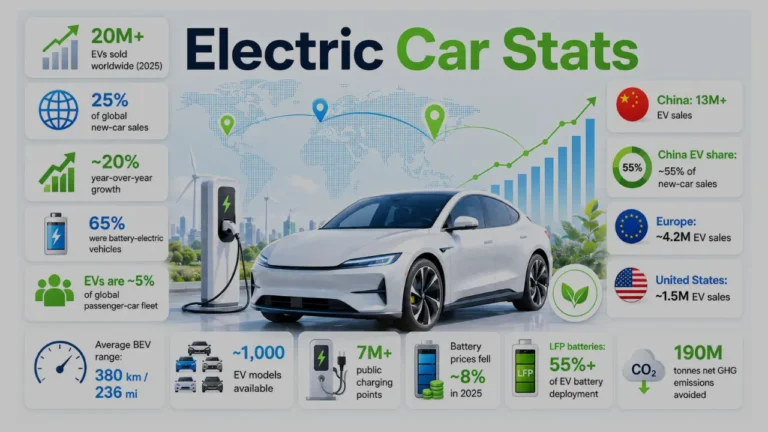
For market data, see the electric car statistics, facts and figures.
Advantages of the Electric Drivetrain
Electric car operation can provide several practical advantages:
- Immediate motor response
- Smooth acceleration
- Quiet low-speed driving
- No tailpipe emissions
- Fewer routine drivetrain service items
- Energy recovery through regenerative braking
- Home-charging capability
- No conventional engine idling
- Flexible front-, rear- or all-wheel-drive layouts
These benefits vary by model and ownership conditions.
A driver without reliable home or workplace charging may have a different experience from someone who can charge overnight.
Limitations of Electric Car Operation
Electric cars also have operating limits that buyers should understand:
- Charging takes longer than filling a fuel tank.
- Range can fall in extreme temperatures.
- Public charging prices and reliability vary.
- Fast-charging speed changes during a session.
- Large batteries add weight.
- Towing can reduce range considerably.
- Battery repairs require specialist equipment.
- The 12-volt battery can still cause starting problems.
- Tyres may wear quickly on heavy or high-powered models.
- Long-distance convenience depends on charging coverage.
These points do not make an EV unsuitable by default. They show why buyers should assess charging access, travel patterns and local conditions before choosing one.
Is an Electric Car Right for You?
An electric car may be a good match when:
- Home or workplace charging is available.
- Daily travel falls comfortably within the vehicle’s range.
- Suitable public chargers are available for longer trips.
- Electricity is reasonably priced.
- The vehicle meets passenger, cargo and towing needs.
- Local servicing and repair support are available.
A buyer should compare more than the advertised range.
Our electric car buying guide can help compare available models by price, range, charging speed and ownership needs.
Frequently Asked Questions
How does an electric car move?
The traction battery sends electricity through an inverter to an electric motor. The motor creates rotational force, and a reduction gear transfers that force to the wheels.
Where does an electric car get its power?
A battery-electric car stores electricity in a rechargeable high-voltage battery pack. The battery is charged from an external electricity supply and receives some recovered energy through regenerative braking.
Does an electric car have a normal engine?
No. A fully electric car has one or more electric motors instead of a petrol or diesel engine.
Does an electric car need oil?
A battery-electric car does not need engine oil because it has no combustion engine. It may still use lubricants and fluids in its reduction gear, cooling system, brakes and air-conditioning system.
Do electric cars have transmissions?
Most electric cars use a single-speed reduction transmission. A small number use more than one forward gear.
How does regenerative braking charge the battery?
When the car slows down, the wheels turn the electric motor. The motor acts as a generator, creating electricity that passes through the power electronics and back into the battery.
Can regenerative braking fully recharge an EV?
No. Regenerative braking recovers only part of the energy used to move the car. The vehicle still needs to be connected to an external charger.
Why do electric cars slow down when the accelerator is released?
The motor may switch into generator mode when the accelerator is released. The resulting resistance slows the vehicle and returns some energy to the battery.
Do electric cars charge while driving?
They can recover some energy through regenerative braking, but they do not create unlimited energy while driving. Their main energy supply still comes from external charging.
What is the purpose of an EV inverter?
The inverter converts and controls electricity between the battery and motor. It changes battery DC power into the form required by the motor and manages reverse energy flow during regenerative braking.
What happens if the EV battery is full during regenerative braking?
Regenerative braking may be reduced when the battery is full or unable to accept more power. The car then relies more heavily on its friction brakes.
Why do electric cars have a 12-volt battery?
The 12-volt battery powers low-voltage electronics and helps activate the high-voltage drivetrain. A discharged 12-volt battery can prevent the car from starting.
Do electric cars work in rain?
Yes. Electric cars and charging systems are designed with insulated high-voltage components, sealed connectors and safety controls. Drivers should still use approved charging equipment and avoid damaged cables or connectors.
How long does an electric car battery last?
Battery life depends on chemistry, climate, charging habits, thermal management and mileage. Buyers should check the manufacturer’s battery warranty and any minimum-capacity guarantee.
Are electric cars automatic?
They are commonly driven like automatic cars because the driver does not operate a clutch or shift through conventional forward gears.
Summary
Electric cars replace the fuel tank and combustion engine with a high-voltage battery, power electronics and one or more electric motors.
When the driver accelerates, electricity travels from the battery through the inverter to the motor. The motor turns the wheels through a reduction gear. When the vehicle slows down, regenerative braking reverses part of that process and sends recovered energy back to the battery.
The operating principle is straightforward, but modern EVs rely on advanced software, battery controls and thermal-management systems to manage performance, charging, safety and efficiency.