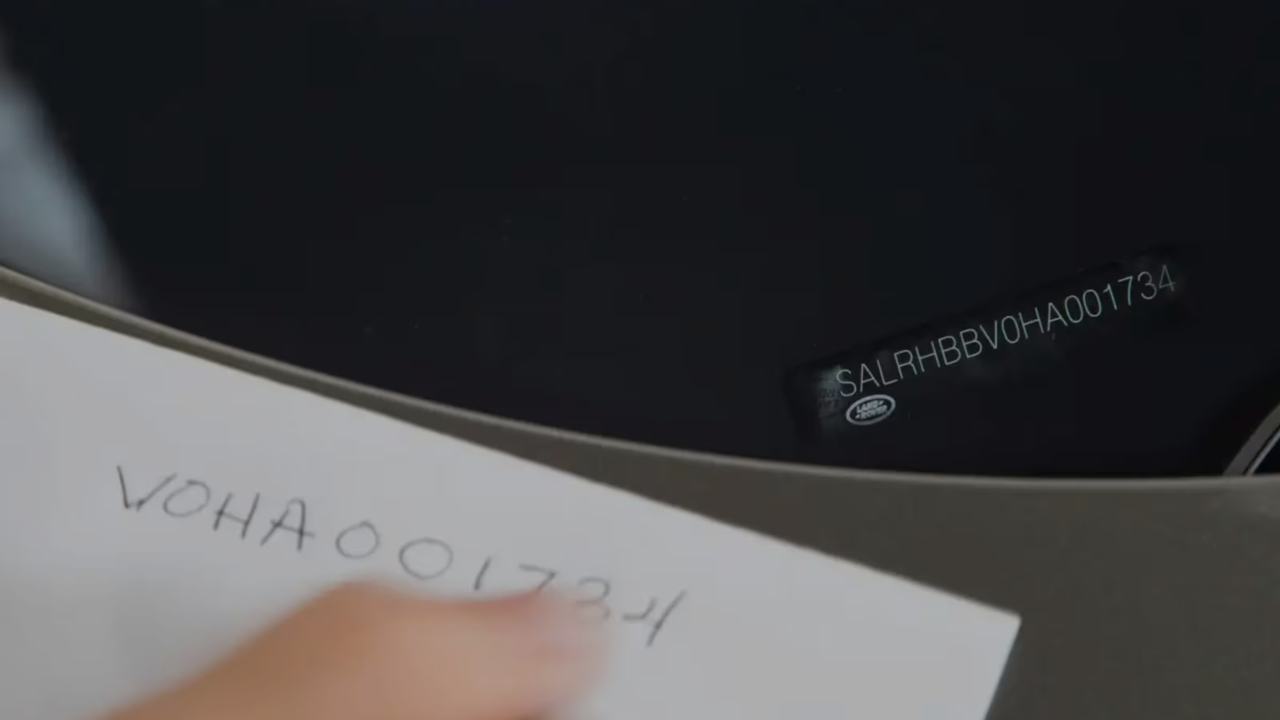
A VIN number is a vehicle identification number. It is a unique 17-character code used to identify a specific car, truck, SUV, motorcycle, trailer, or other road vehicle.
You can read a VIN by splitting it into sections. The first three characters identify the manufacturer, characters 4–8 describe the vehicle, character 9 is a check digit, character 10 shows the model year, character 11 identifies the assembly plant, and characters 12–17 are the vehicle’s production sequence.
NHTSA states that each motor vehicle must contain a 17-character VIN that encodes information about that particular vehicle.
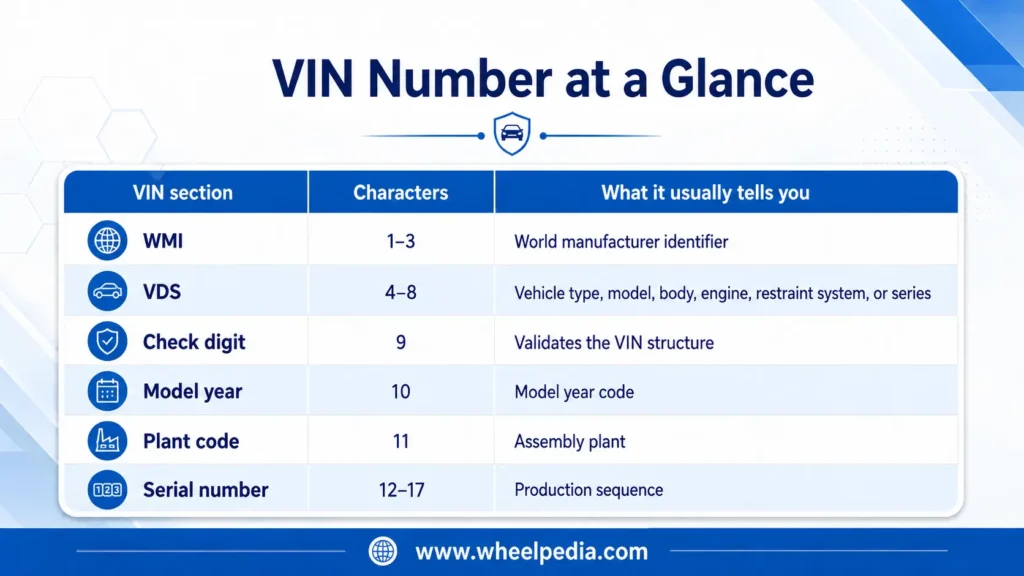
A VIN is read from left to right in three main sections: WMI for manufacturer, VDS for vehicle details, and VIS for model year, plant, and serial number. The 10th character is commonly used to identify model year, while the 9th character is a check digit used to help validate the VIN.
What Is a VIN Number?
A VIN is a vehicle’s unique identification code.
It works like a fingerprint for the vehicle. No two vehicles subject to U.S. federal motor vehicle safety standards and made within a 60-year period beginning with the 1980 model year should have identical VINs.
A VIN can help identify:
- Manufacturer
- Vehicle type
- Model year
- Assembly plant
- Engine or drivetrain information
- Body style
- Safety equipment
- Production sequence
- Recall eligibility
- Title and registration records
- Accident or theft records when checked through proper databases
A VIN is not the same as a license plate. A license plate can change when a vehicle is registered in a different place. The VIN stays with the vehicle.
Where to Find the VIN Number
Common VIN locations include:
- Dashboard near the windshield on the driver’s side
- Driver-side door jamb or door pillar
- Vehicle registration documents
- Insurance documents
- Title or ownership documents
- Loan or lease paperwork
- Service records
- Manufacturer app or owner portal
- Under the hood on some vehicles
- Frame or chassis area on some vehicles
- Motorcycle steering neck or frame
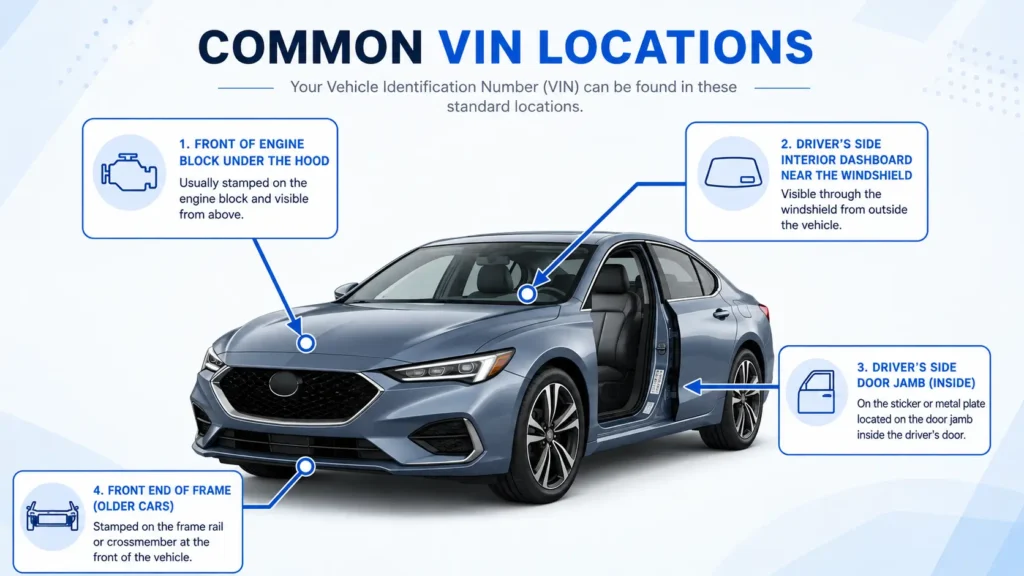
When buying a used car, check that the VIN on the dashboard, door label, title, registration, and seller documents all match.
How Many Characters Are in a VIN?
Modern VINs usually have 17 characters.
For U.S. and Canadian vehicles, 1981 and later model-year cars use a 17-character VIN format.
A VIN may contain letters and numbers, but it does not use the letters I, O, or Q because they can be confused with 1 and 0.
If a modern VIN has fewer than 17 characters, contains invalid characters, or does not match the vehicle documents, treat it as a red flag.
How to Read a VIN Number Character by Character
A 17-character VIN is usually organized like this:
| Position | Name | Meaning |
| 1 | Country or region/manufacturer area | Where the manufacturer is registered or vehicle origin category |
| 2 | Manufacturer | Brand or manufacturer code |
| 3 | Vehicle type or manufacturing division | Vehicle category or manufacturer division |
| 4 | Vehicle descriptor | Model, line, body, engine, restraint, or series info |
| 5 | Vehicle descriptor | Model, line, body, engine, restraint, or series info |
| 6 | Vehicle descriptor | Model, line, body, engine, restraint, or series info |
| 7 | Vehicle descriptor | Model, line, body, engine, restraint, or series info |
| 8 | Vehicle descriptor | Model, line, body, engine, restraint, or series info |
| 9 | Check digit | VIN validation character |
| 10 | Model year | Model year code |
| 11 | Assembly plant | Factory or plant code |
| 12–17 | Serial number | Production sequence |
NHTSA’s VIN decoding information labels positions 1–3 as WMI, positions 4–8 as VDS, position 9 as the check digit, and positions 10–17 as VIS.
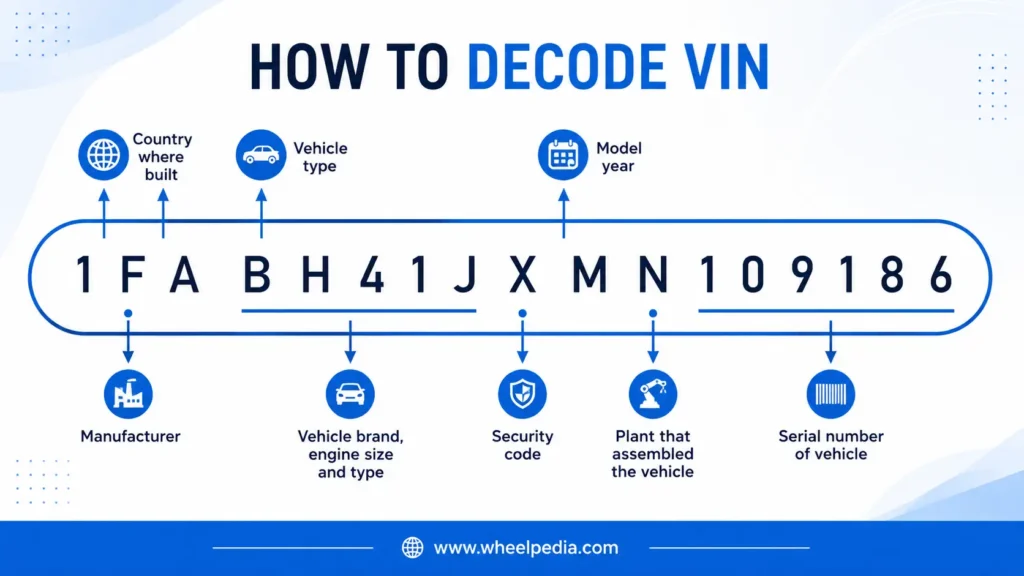
Characters 1–3: World Manufacturer Identifier
The first three characters are called the World Manufacturer Identifier, or WMI.
This section identifies the manufacturer and sometimes the country, region, or vehicle type.
For example, the first character often points to a broad manufacturing region or country code. The next characters identify the manufacturer or vehicle division.
Examples:
| First character | Common meaning |
| 1, 4, 5 | United States |
| 2 | Canada |
| 3 | Mexico |
| J | Japan |
| K | South Korea |
| S | United Kingdom |
| W | Germany |
| Z | Italy |
These are common examples, but VIN interpretation can vary by manufacturer and market. Use an official VIN decoder for final confirmation.
Characters 4–8: Vehicle Descriptor Section
Characters 4 through 8 form the Vehicle Descriptor Section, or VDS.
This section may describe:
- Model
- Body style
- Engine type
- Transmission
- Series
- Trim family
- Restraint system
- Gross vehicle weight class
- Drivetrain
- Vehicle platform
The exact meaning of characters 4–8 is manufacturer-specific. A Toyota VIN, Ford VIN, BMW VIN, Hyundai VIN, and Mercedes-Benz VIN may use different coding rules in this section.
This is why a generic VIN guide can explain the structure, but a manufacturer database or official VIN decoder is needed for exact decoding.
Character 9: Check Digit
The 9th character is the check digit.
It is used to help verify whether the VIN is valid. In the U.S. VIN format, the check digit appears in position 9.
The check digit is calculated from the other VIN characters using a mathematical formula. If the check digit does not match, the VIN may have been entered incorrectly, printed incorrectly, or altered.
A failed check digit does not automatically prove fraud in every global context, but it is a strong reason to double-check the VIN and documents.
Character 10: Model Year
The 10th character usually identifies the vehicle’s model year.
This is very useful when buying a used car because the model year may differ from the calendar year when the car was built, sold, or first registered.
Common recent model-year codes include:
| 10th character | Model year |
| A | 2010 |
| B | 2011 |
| C | 2012 |
| D | 2013 |
| E | 2014 |
| F | 2015 |
| G | 2016 |
| H | 2017 |
| J | 2018 |
| K | 2019 |
| L | 2020 |
| M | 2021 |
| N | 2022 |
| P | 2023 |
| R | 2024 |
| S | 2025 |
| T | 2026 |
| V | 2027 |
| W | 2028 |
| X | 2029 |
| Y | 2030 |
| 1 | 2031 |
| 2 | 2032 |
| 3 | 2033 |
| 4 | 2034 |
| 5 | 2035 |
| 6 | 2036 |
| 7 | 2037 |
| 8 | 2038 |
| 9 | 2039 |
VIN model-year codes repeat in cycles, so the 10th character should be interpreted with the vehicle’s make, model, design generation, and other VIN details.
Character 11: Assembly Plant
The 11th character identifies the assembly plant.
This tells you which factory built the vehicle.
Plant codes are manufacturer-specific. The same letter can mean different plants for different brands.
For example, one manufacturer may use one letter for a U.S. plant, while another manufacturer may use the same letter for a different plant in another country.
Use a brand-specific VIN decoder when plant location matters.
Characters 12–17: Serial Number
Characters 12 through 17 are the vehicle’s production sequence or serial number.
This section helps identify the specific unit built by the manufacturer.
The serial number can be useful for:
- Confirming exact vehicle identity
- Service campaigns
- Recall ranges
- Production batches
- Manufacturer warranty records
- Parts matching
- Theft and title checks
Two cars with similar VINs may be the same model, trim, year, and plant, but the final serial sequence identifies each vehicle individually.
Example VIN Breakdown
Here is a simplified example VIN:
1HGCM82633A004352
| Position | Character | Meaning |
| 1 | 1 | Region/country code |
| 2 | H | Manufacturer code |
| 3 | G | Vehicle type/division |
| 4–8 | CM826 | Vehicle descriptor section |
| 9 | 3 | Check digit |
| 10 | 3 | Model year code |
| 11 | A | Assembly plant code |
| 12–17 | 004352 | Production sequence |
This example shows the structure. Exact details should be confirmed with a proper VIN lookup tool.
What a VIN Can Tell You
A VIN can help reveal:
- Model year
- Make
- Model
- Body style
- Engine type
- Trim or series
- Assembly plant
- Safety equipment
- Vehicle type
- Recall information
- Manufacturer records
- Title history when checked through title databases
- Reported accident or theft history from paid or official records
NHTSA offers a VIN decoder where users can enter a VIN to identify vehicle information and safety-related details.
What a VIN Cannot Tell You by Itself
A VIN is useful, but it does not automatically tell the full ownership story.
A VIN by itself may not show:
- Actual current condition
- Hidden mechanical problems
- Complete maintenance history
- All accident repairs
- Flood damage if never reported
- Odometer tampering if not recorded
- Battery health on used EVs
- Current market value
- Whether the seller is honest
- Whether the title is clean in every database
Use the VIN as a starting point, not the whole inspection.
Why VIN Checks Matter When Buying a Used Car
A VIN check helps protect buyers from mistakes and fraud.
Before buying a used car, the VIN can help you check:
- Does the VIN match the title?
- Does the VIN match the dashboard and door label?
- Is the model year correct?
- Is the car the trim the seller claims?
- Are there open recalls?
- Is there a reported salvage or rebuilt title?
- Is there a theft record?
- Is the mileage history consistent?
- Does the accident history match the seller’s story?
- Are there manufacturer service campaigns?
The VIN should be checked before payment, deposit, or loan signing.
VIN and Recall Checks
A VIN is important for recall checks because recalls can apply to specific production ranges, plants, components, or build dates.
NHTSA’s recall tools allow owners and buyers to search by VIN to check for unrepaired safety recalls on many vehicles.
When buying a used car, ask:
- Are there open recalls?
- Has recall work been completed?
- Is proof available?
- Does a dealer need to perform the repair?
- Is the vehicle safe to drive before the repair?
Recall repairs are usually performed by authorized dealers for the affected brand, but details vary by market and recall type.
VIN and Vehicle History Reports
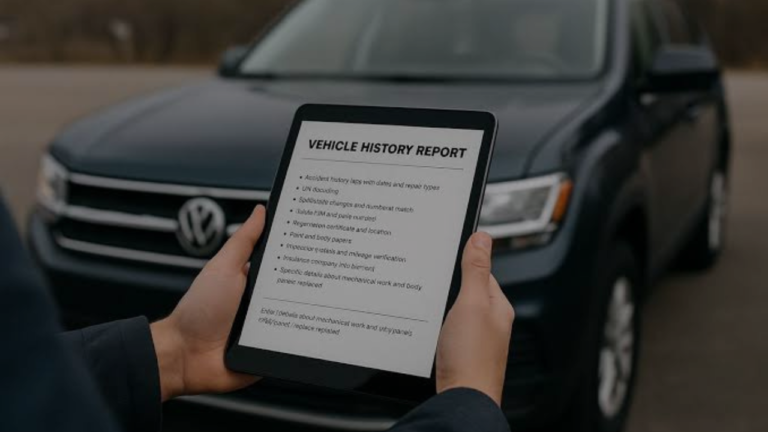
A VIN can be used to order vehicle history reports from trusted services or check official databases.
A vehicle history report may show:
- Title branding
- Reported accidents
- Odometer readings
- Registration history
- Previous use
- Theft records
- Salvage auction records
- Lemon-law branding where available
- Service events reported to the database
But not every accident, repair, or service visit appears on a history report.
A clean vehicle history report is not a substitute for a pre-purchase inspection.
VIN and Odometer Checks
The VIN can help compare recorded mileage over time.
Look for:
- Mileage on inspection records
- Mileage on service invoices
- Mileage on title records
- Mileage on vehicle history reports
- Mileage on emissions tests
- Mileage in dealer listings
Red flags include:
- Mileage dropping between records
- Big unexplained gaps
- Odometer reading inconsistent with wear
- Replacement instrument cluster without documentation
- Seller refusing history documents
Mileage should match the condition of the seats, pedals, steering wheel, tyres, service records, and maintenance history.
VIN and Title Checks
The VIN should match the title or ownership document exactly.
Check for:
- Salvage title
- Rebuilt title
- Flood title
- Lemon branding
- Odometer branding
- Export/import records
- Lienholder information
- Name on title
- Title transfer restrictions
Do not buy a car if the VIN on the car does not match the title unless the issue is clearly explained and legally corrected.
VIN and Insurance
Insurers use the VIN to identify the exact vehicle.
A VIN can affect insurance quotes because it can identify:
- Model year
- Make and model
- Engine
- Body type
- Safety equipment
- Theft risk
- Repair cost
- Trim or variant
Before buying a car, request an insurance quote using the exact VIN, not just the make and model.
VIN and Financing
Lenders use the VIN to confirm the vehicle being financed.
The VIN helps the lender verify:
- Vehicle identity
- Year, make, and model
- Vehicle value
- Title status
- Lien eligibility
- Insurance requirements
- Loan-to-value ratio
If the VIN does not decode correctly or the title has problems, the lender may refuse financing.
Read Guide: How Car Financing Works
VIN and Used EVs
VIN checks are useful for electric cars, but they do not replace battery testing.
For a used EV, the VIN may help confirm:
- Model year
- Battery version or trim in some cases
- Recall status
- Warranty eligibility
- Vehicle history
- Title status
- Manufacturer records
But the VIN alone may not prove:
- Battery state of health
- Real-world range
- Charging performance
- Fast-charging history
- Battery repair history
- Degradation level
For used EVs, combine a VIN check with battery-health information, charging tests, and service records.
Read Guide: What to Check Before Buying a Used EV
VIN Red Flags When Buying a Used Car
Be careful if:
- VIN on dashboard does not match title
- VIN plate looks damaged or replaced
- Door-label VIN is missing
- VIN has fewer than 17 characters on a modern vehicle
- VIN contains I, O, or Q
- Seller refuses to provide VIN
- VIN check shows a different model year
- VIN check shows a different engine or body style
- Vehicle history shows salvage or flood title
- Odometer records do not match
- Open safety recalls are ignored
- Lender or insurer cannot verify the VIN
- VIN appears altered, scratched, or covered
- Documents show different VINs
Walk away or get expert help if the VIN story is unclear.
How to Check a VIN Before Buying
Use this checklist:
- Find the VIN on the dashboard.
- Check the driver-side door jamb label.
- Compare it with the title or ownership document.
- Compare it with registration and insurance documents.
- Decode the VIN using an official or trusted decoder.
- Check for open recalls.
- Run a vehicle history report if buying used.
- Compare mileage records.
- Check title branding.
- Ask for service records.
- Get a pre-purchase inspection.
- Confirm the VIN with your insurer.
- Confirm the VIN with your lender if financing.
Do not send money before confirming the VIN and ownership documents.
How to Decode a VIN Online
You can decode a VIN manually, but online tools are faster and more accurate.
Useful VIN checks include:
- Official government VIN decoder
- Manufacturer owner portal
- Recall lookup
- Vehicle history report
- Insurance quote
- Lender verification
- Dealer service department check
For U.S.-market vehicles, NHTSA’s VIN decoder is a helpful starting point for basic vehicle information.
Frequently Asked Questions
What is a VIN number?
A VIN is a vehicle identification number. It is a unique 17-character code assigned to a specific vehicle.
How many characters are in a VIN?
Modern VINs usually have 17 characters. U.S. and Canadian vehicles from 1981 onward use the 17-character format.
What does the first digit of a VIN mean?
The first digit usually points to a broad manufacturing region or country code, depending on the VIN system and market.
What do the first three characters of a VIN mean?
The first three characters are the World Manufacturer Identifier, which identifies the manufacturer and sometimes vehicle type or division.
What does the 9th character in a VIN mean?
The 9th character is the check digit. It helps validate the VIN.
What does the 10th character in a VIN mean?
The 10th character usually identifies the model year.
What does the 11th character in a VIN mean?
The 11th character identifies the assembly plant.
What do the last six digits of a VIN mean?
The last six characters are usually the production sequence or serial number.
Can a VIN tell the exact trim?
Sometimes, but not always. The VIN may identify trim, engine, or series depending on the manufacturer. Use a brand-specific decoder for exact details.
Can a VIN tell if a car was in an accident?
The VIN itself does not show accidents, but it can be used to search vehicle history databases that may include reported accidents.
Can a VIN show recalls?
Yes. A VIN can be used to check open safety recalls through official recall tools.
Where is the VIN located on a car?
Common locations include the driver-side dashboard near the windshield and the driver-side door jamb.
Is the VIN the same as the chassis number?
In many markets, VIN and chassis number are used similarly, but local terminology can vary.
What letters are not used in VINs?
Modern VINs do not use I, O, or Q because they can be confused with numbers.
Should I share a VIN with a buyer?
Yes, generally. Serious buyers need the VIN for history, recall, insurance, and lender checks. Avoid sharing unnecessary personal documents with it.
Summary
Learning how to read a VIN number helps you understand what a vehicle is and whether its documents match its identity.
The most important positions are easy to remember: characters 1–3 identify the manufacturer, 4–8 describe the vehicle, 9 is the check digit, 10 is the model year, 11 is the assembly plant, and 12–17 are the production sequence.
A VIN is one of the first things to check when buying a used car. It can help confirm model year, trim, recall status, title history, and whether the seller’s story matches the vehicle records.
But a VIN is not a full inspection. Always combine VIN checks with service records, title verification, mileage review, insurance quote, and a proper mechanical inspection before buying.