
Ford Bronco: Price, Specs, MPG & Features
The Ford Bronco is a truck-based off-road SUV available with two or four doors, removable roof panels, removable doors, standard four-wheel drive, and three turbocharged engine choices. It combines serious trail ability with enough comfort and technology for regular road use.
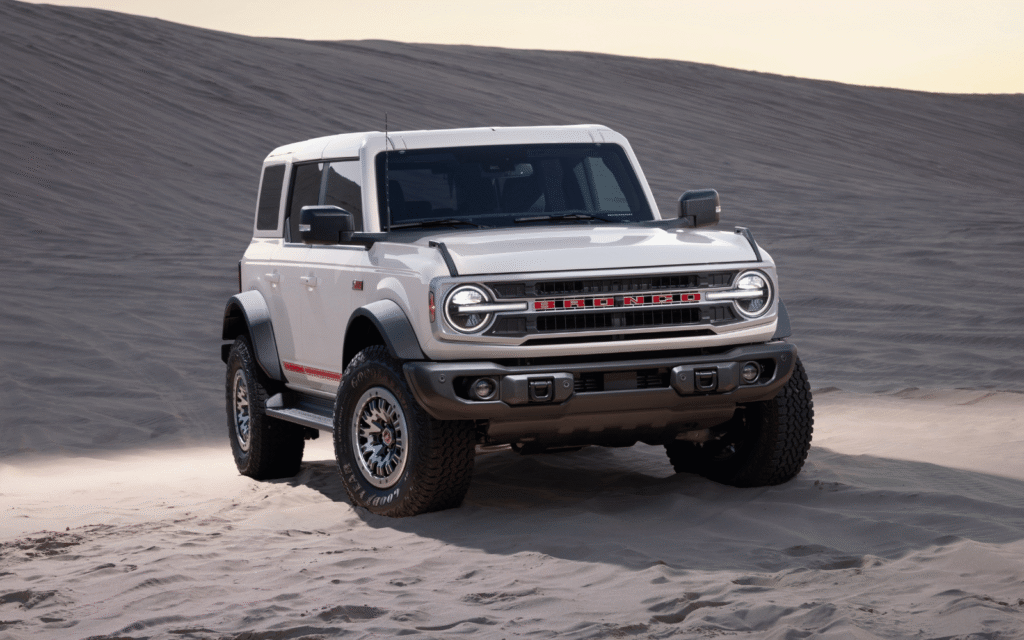
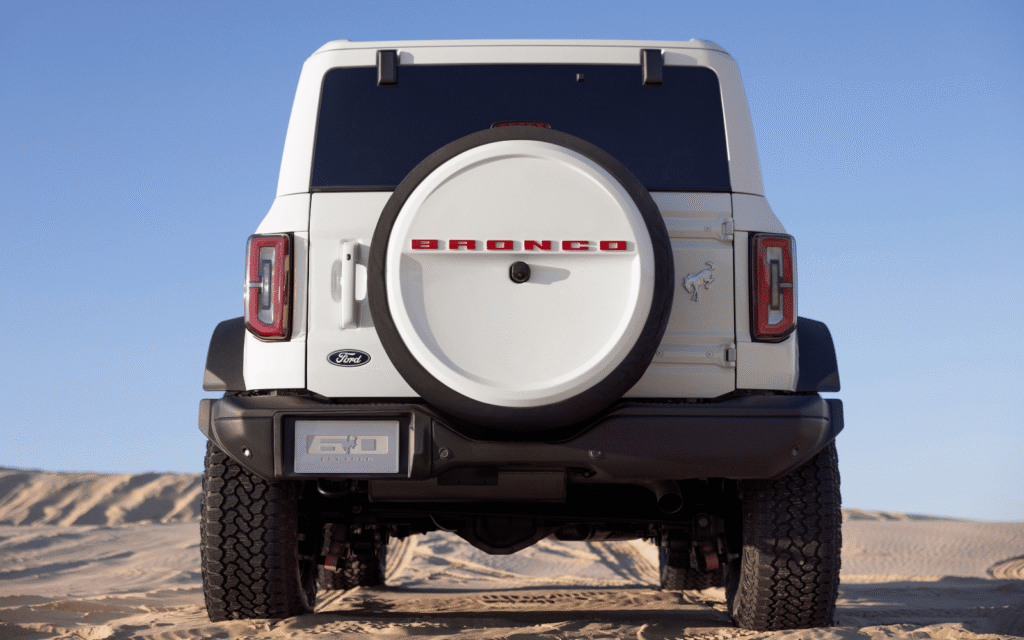
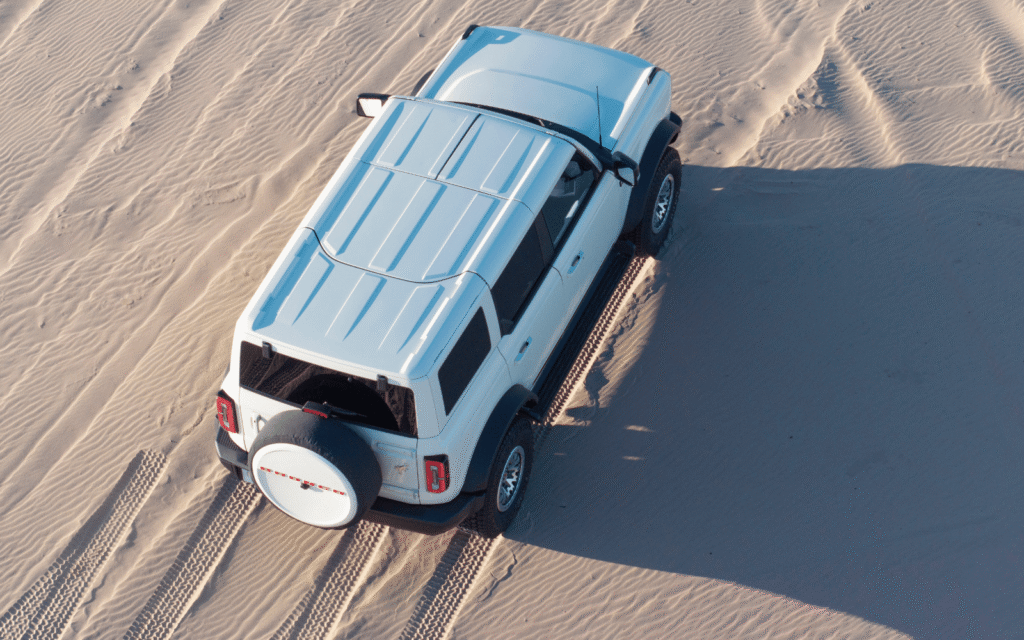
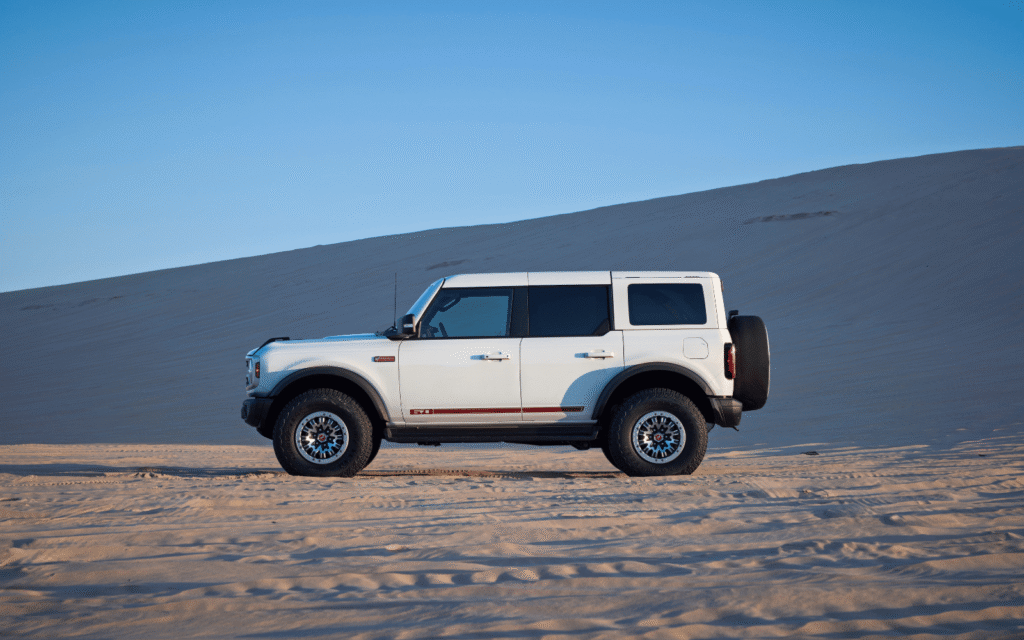
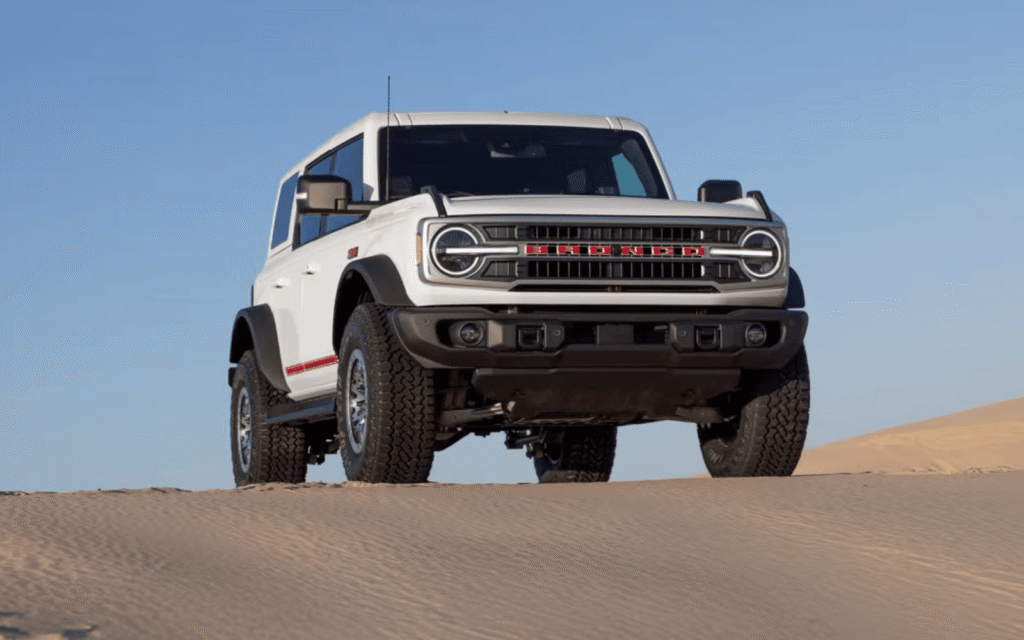
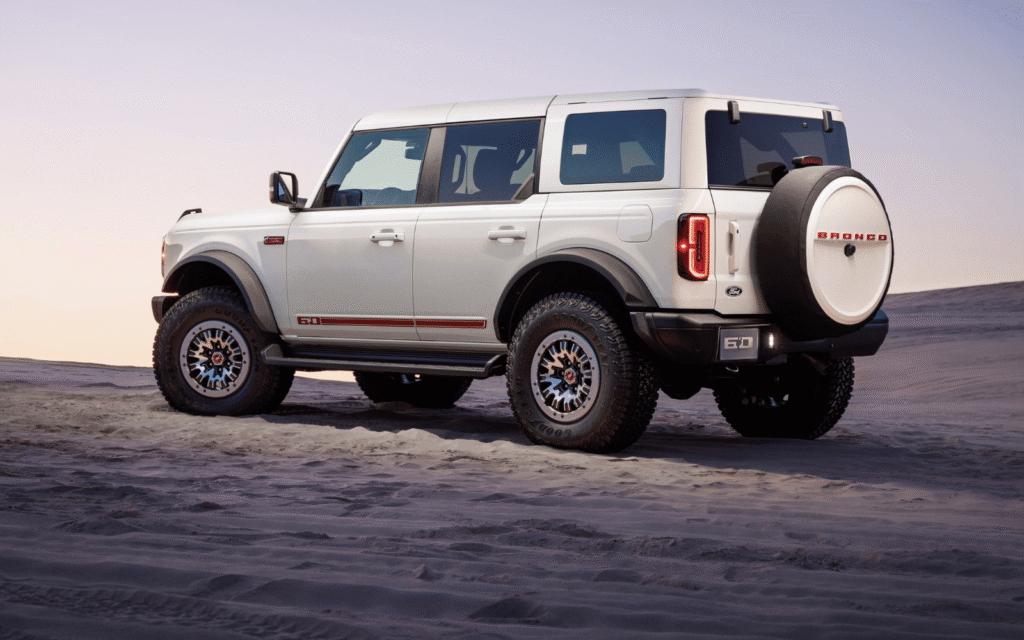
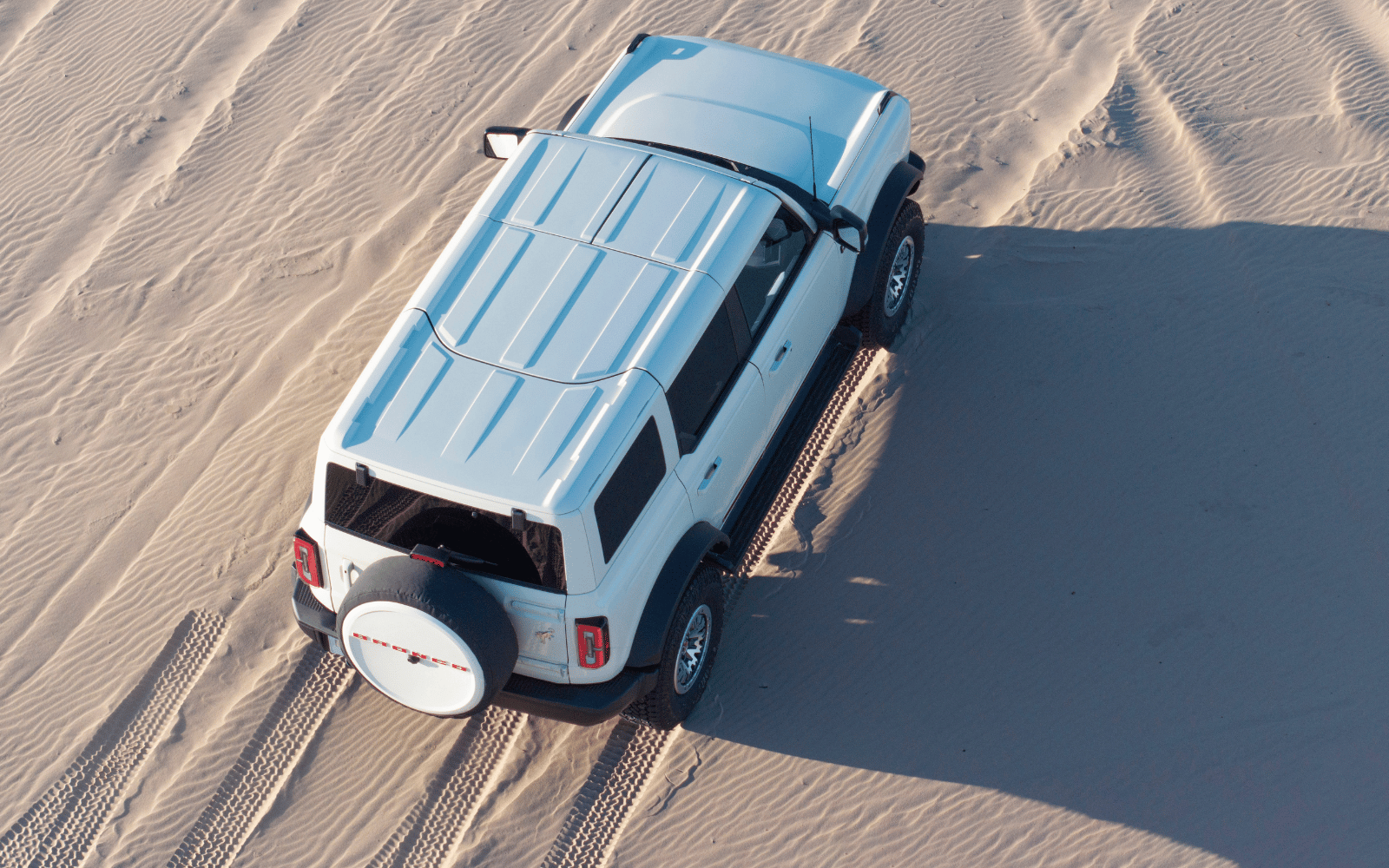
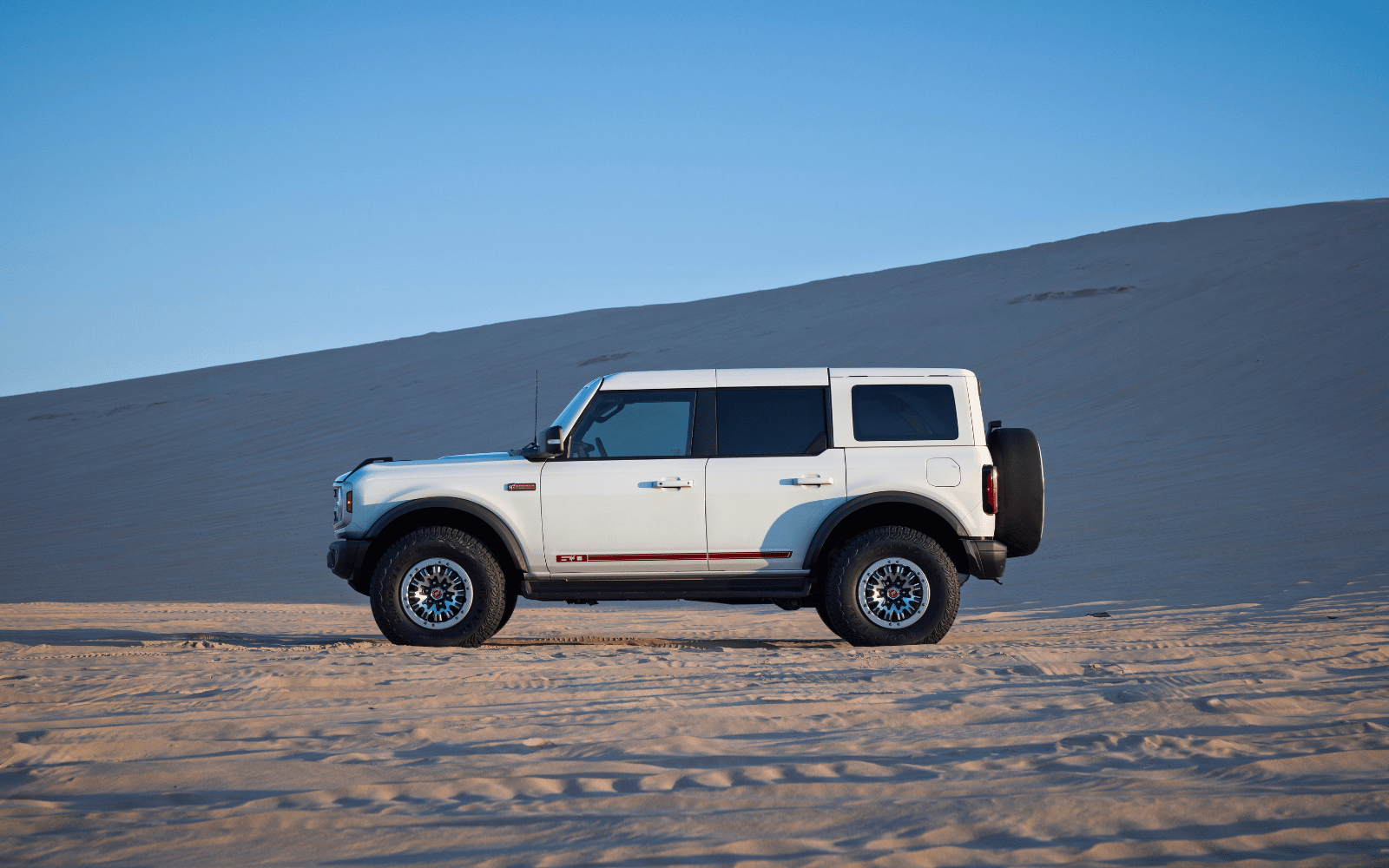
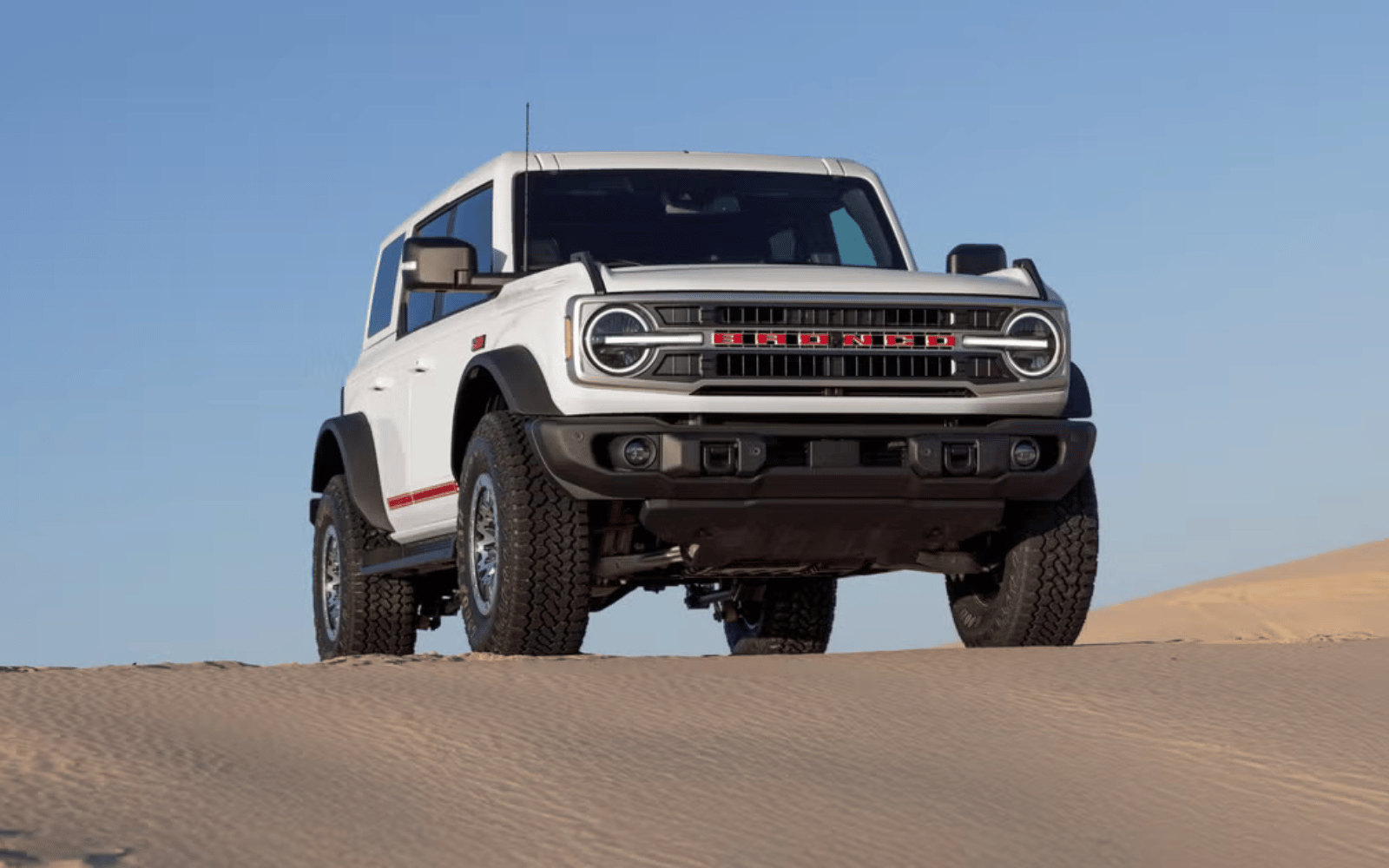
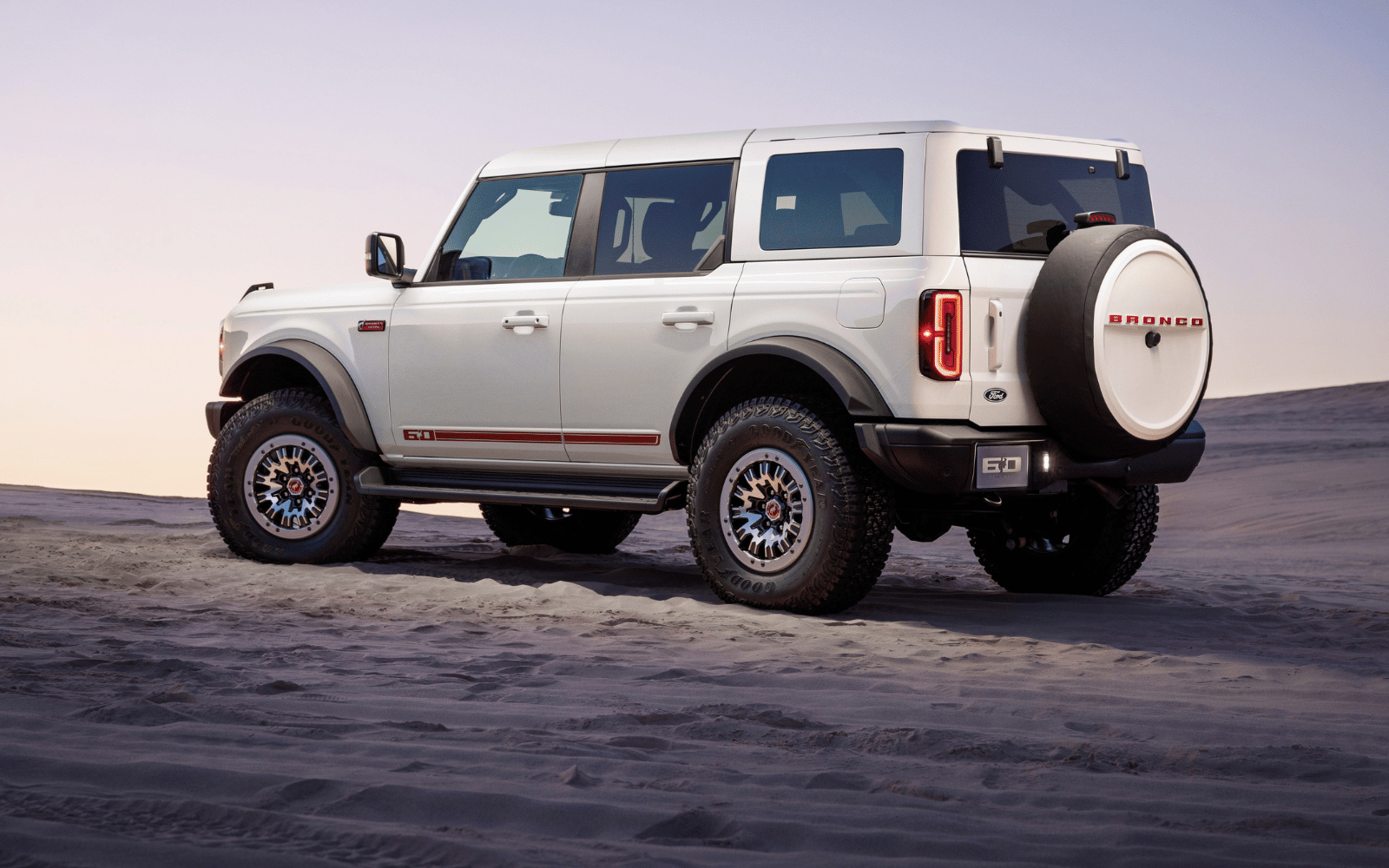
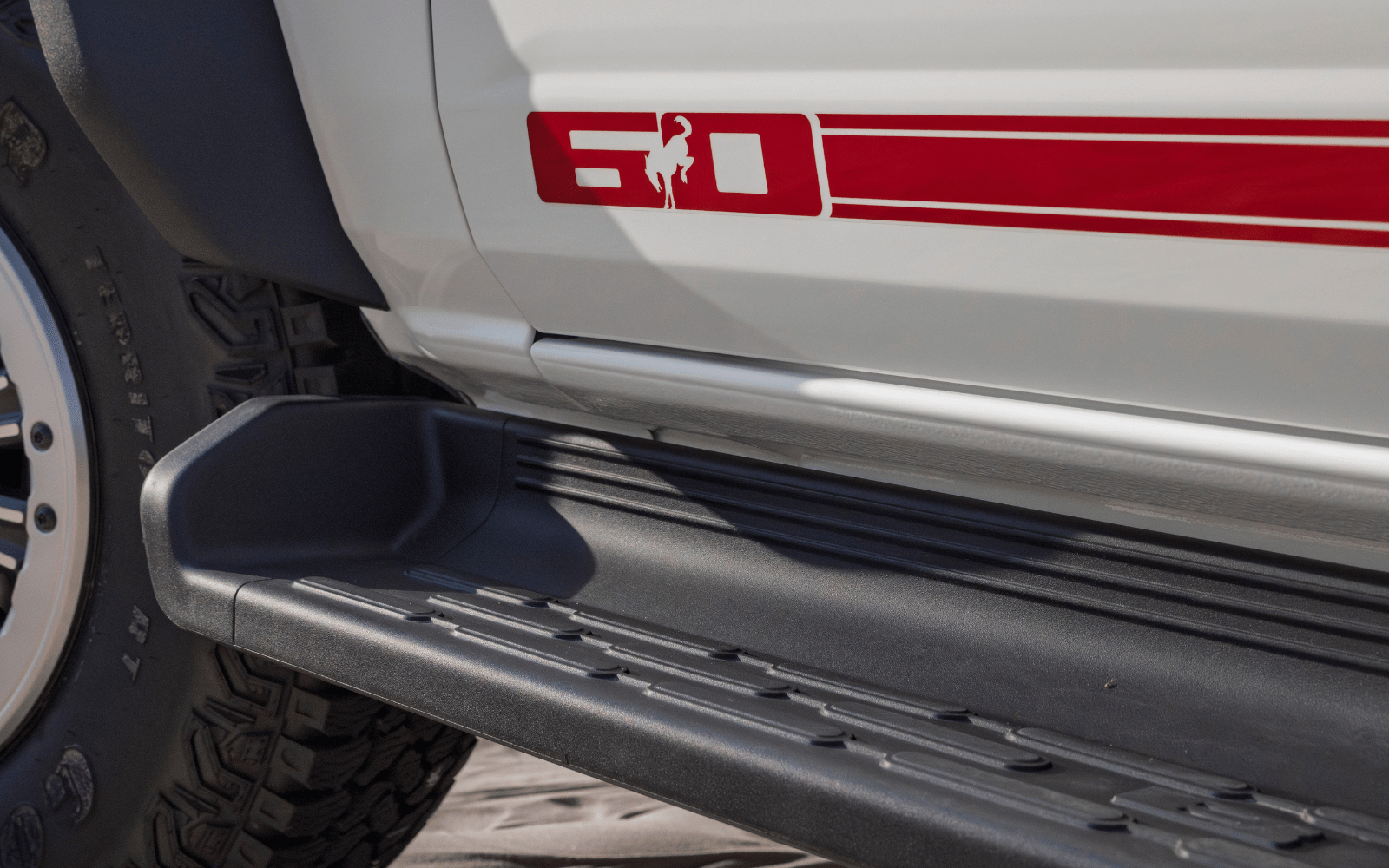
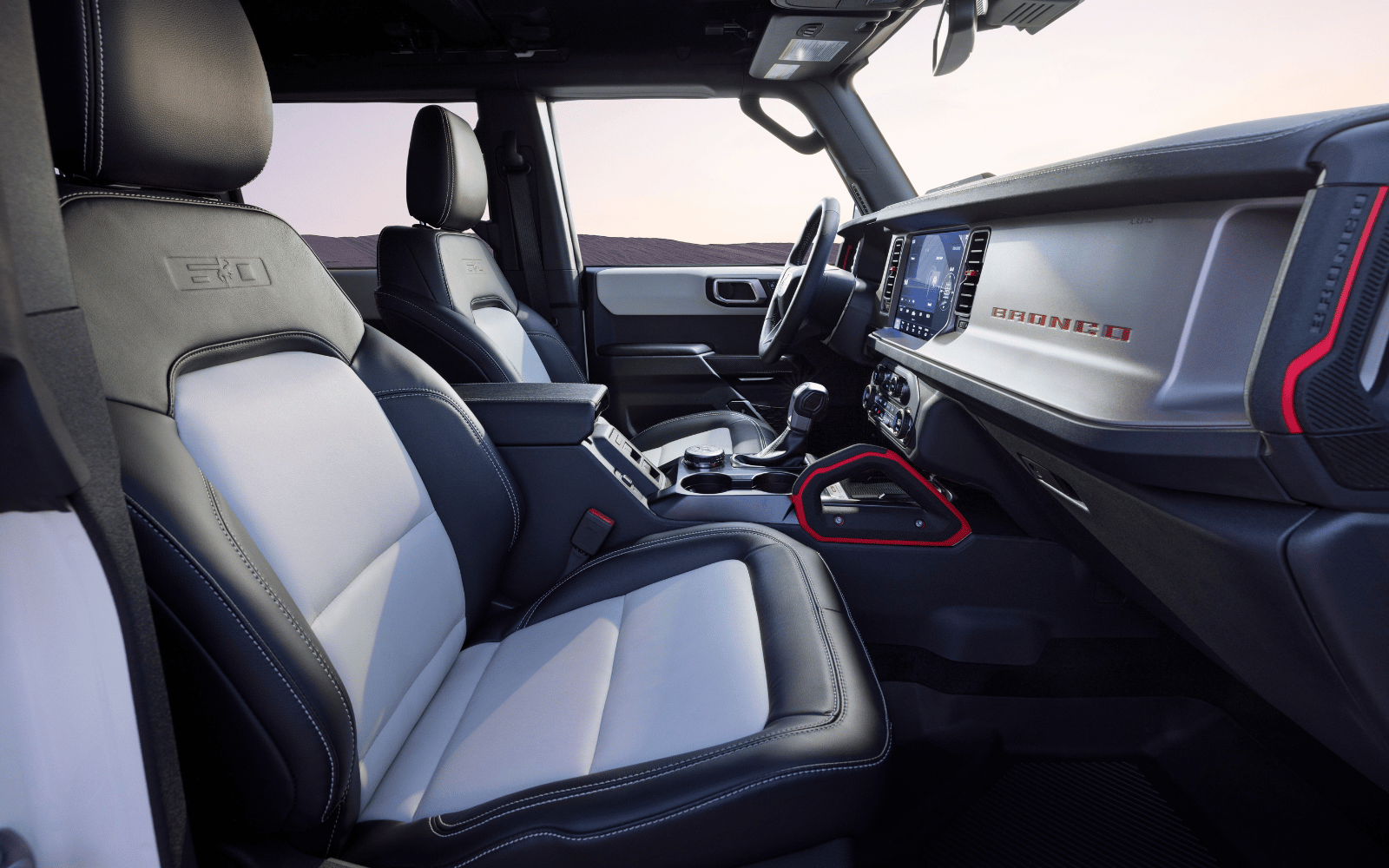
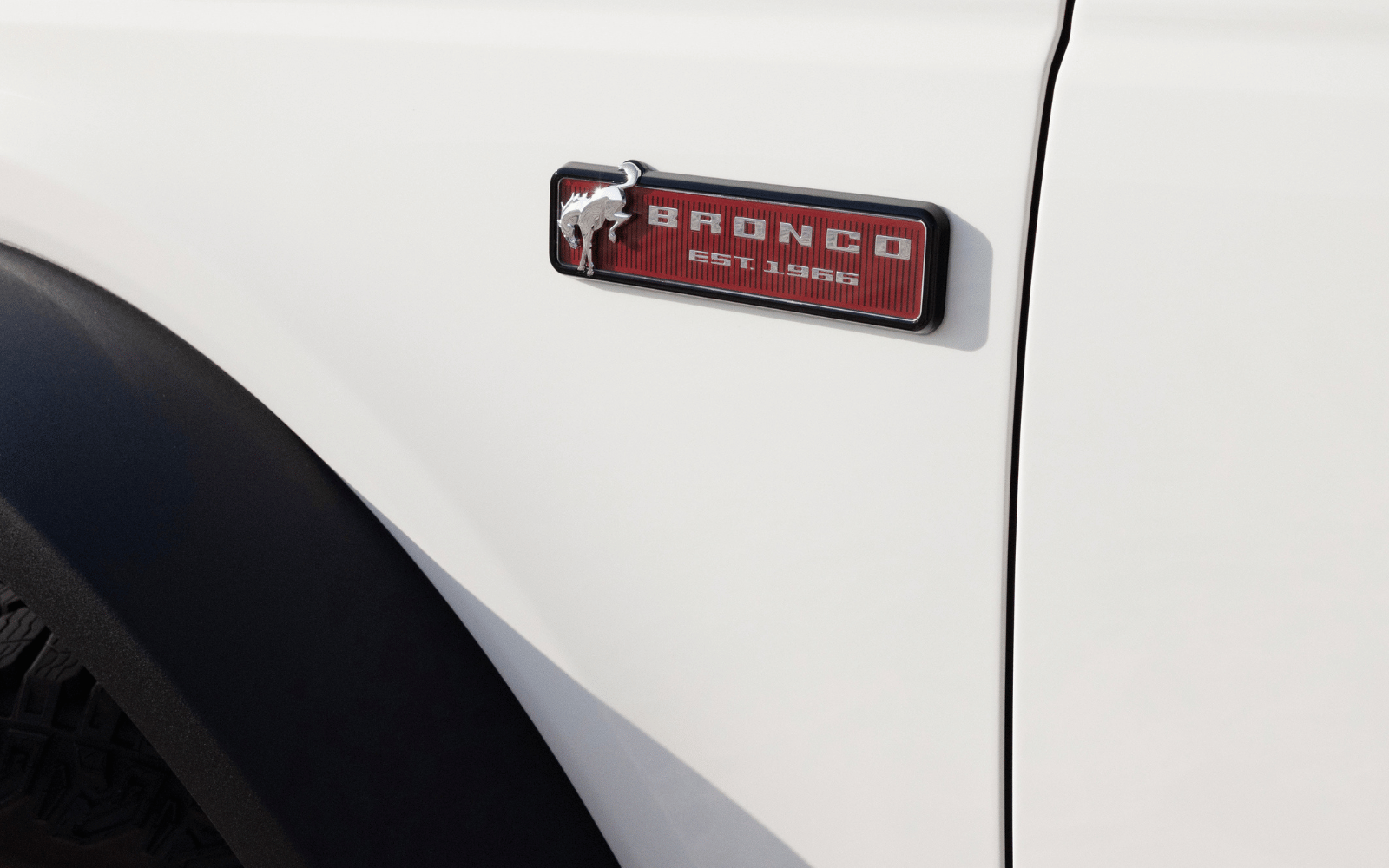
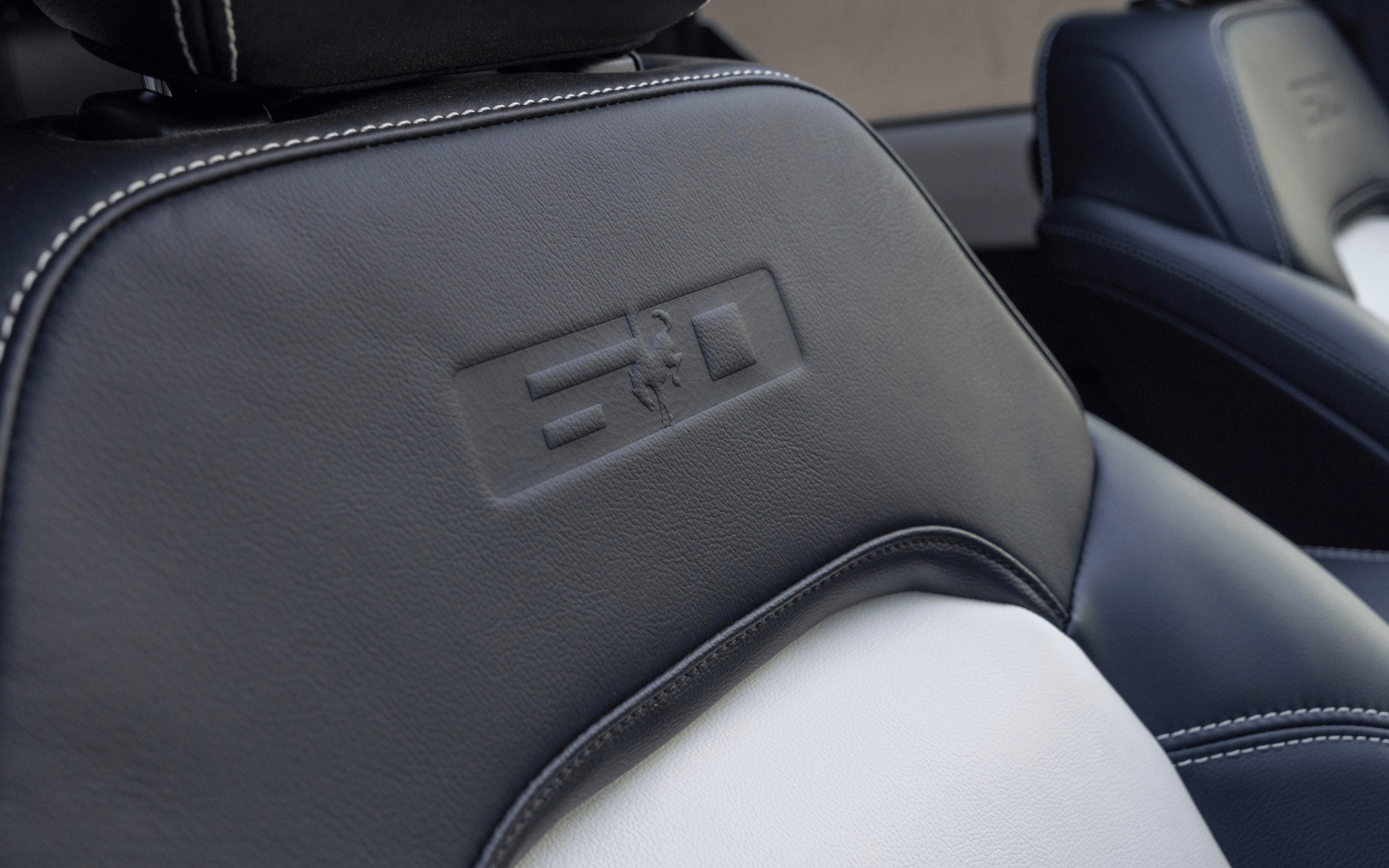
Buyers can choose a seven-speed manual or ten-speed automatic transmission, depending on the engine and trim. Available equipment ranges from the value-focused Sasquatch Package to the 418-horsepower Bronco Raptor with 37-inch tires and 13.1 inches of ground clearance.
This page covers the body-on-frame Ford Bronco. The smaller, car-based Bronco Sport is a separate model.
WheelPedia Rating: 8.1/10
The Ford Bronco earns an 8.1/10 WheelPedia Rating for its off-road ability, configurable design, strong engine range, available manual transmission, practical four-door body, and competitive pricing.
It loses points for fuel consumption, road noise, expensive packages, average interior materials in some trims, and a Marginal result in the updated IIHS moderate-overlap front test.
| Rating Category | Score | Weight |
| Safety | 8.2/10 | 20% |
| Reliability and ownership | 7.8/10 | 15% |
| Performance and driving | 9.4/10 | 15% |
| Comfort and practicality | 8.0/10 | 15% |
| Efficiency | 6.5/10 | 15% |
| Features and technology | 8.6/10 | 10% |
| Price and value | 8.5/10 | 10% |
| Overall WheelPedia Rating | 8.1/10 | — |
See how we rate cars for the complete scoring method.
Key Highlights
- Starts from $40,795 MSRP before destination and other charges.
- Available with two or four doors.
- Standard four-wheel drive across the lineup.
- Removable doors and roof panels support open-air driving.
- Standard 300-hp turbocharged 2.3-liter four-cylinder.
- Available 330-hp twin-turbocharged 2.7-liter V6.
- Bronco Raptor uses a 418-hp twin-turbocharged 3.0-liter V6.
- Seven-speed manual available with the 2.3-liter engine.
- Ten-speed automatic available or standard, depending on configuration.
- Sasquatch Package adds 35-inch tires and more off-road hardware.
- Up to 13.1 inches of ground clearance.
- Up to 37 inches of water-fording capability.
- Maximum towing capacity of 4,500 pounds in the Raptor.
- Seats four in two-door models and five in four-door models.
- Best for drivers who want real trail ability without giving up everyday usability.
Quick Specifications
| Specification | Ford Bronco |
| Vehicle type | Body-on-frame off-road SUV |
| Body styles | 2-door and 4-door |
| Seating capacity | 4 or 5 |
| Standard engine | 2.3L turbocharged four-cylinder |
| Standard output | 300 hp / 325 lb-ft |
| Available engine | 2.7L twin-turbocharged V6 |
| Available V6 output | 330 hp / 415 lb-ft |
| Raptor engine | 3.0L twin-turbocharged V6 |
| Raptor output | 418 hp / 440 lb-ft |
| Transmissions | 7-speed manual or 10-speed automatic |
| Drivetrain | Four-wheel drive |
| Maximum towing capacity | 4,500 lbs |
| Maximum ground clearance | 13.1 in. |
| Maximum water fording | 37.0 in. |
| Best fuel economy | Up to approximately 20 mpg combined |
| Two-door maximum cargo space | 52.0 cu. ft. |
| Four-door maximum cargo space | Up to 83.0 cu. ft. |
Expert Tip
The four-door Big Bend with the Sasquatch Package is the strongest value for buyers who want serious trail hardware without paying for a high trim. Choose the Badlands instead if you need the front stabilizer-bar disconnect, stronger underbody protection, and more technical rock-crawling ability.
About the Ford Bronco
The Bronco is designed around off-road driving rather than simply looking like an off-road vehicle. Every model has four-wheel drive, a low-range transfer case, useful ground clearance, exposed recovery points, and selectable terrain modes.
Two-door models are shorter and easier to position on narrow trails. Four-door models provide more rear-seat space, easier passenger access, and a much larger cargo area. The four-door is the better everyday vehicle for most buyers, while the two-door has better proportions and a shorter wheelbase for technical off-road use.
Removable frameless doors and removable roof sections let owners create an open-air driving experience. Ford also places the side mirrors on the body rather than the doors, so the mirrors remain usable when the doors are removed.
Price and Trims
The following prices are starting MSRPs before destination, taxes, registration, options, accessories, and dealer charges. Body style, engine, transmission, and packages can change the final price.
| Trim | Starting MSRP | Main Powertrain | Key Reason to Choose |
| Base | $40,795 | 300-hp 2.3L turbo four | Lowest entry price and available Sasquatch Package |
| Big Bend | $41,790 | 300-hp 2.3L turbo four | Best balance of price, comfort, and package availability |
| Outer Banks | $48,685 | 300-hp four; available 330-hp V6 | More comfort, technology, and street-focused styling |
| Badlands | $49,385 | 300-hp four; available 330-hp V6 | Best technical off-road value |
| Heritage Edition | $52,120 | 300-hp four; available 330-hp V6 | Retro styling with standard 35-inch tires |
| Stroppe Edition | $69,995 | 330-hp 2.7L V6 | Baja-inspired styling and HOSS 3.0 suspension |
| Raptor | $80,990 | 418-hp 3.0L V6 | Maximum power and high-speed off-road ability |
Pricing can rise quickly. A four-door body, V6 engine, automatic transmission, Sasquatch Package, Lux Package, upgraded roof, leather seating, premium paint, and dealer-installed accessories can add thousands of dollars.
Engine, Powertrain, and Performance
2.3-Liter EcoBoost Four-Cylinder
The standard turbocharged 2.3-liter four-cylinder produces 300 horsepower and 325 lb-ft of torque when using the fuel required for the advertised output.
It can be paired with a seven-speed manual or ten-speed automatic on selected trims. The manual has six conventional forward gears plus an extra-low crawler gear for slow off-road driving.
The 2.3-liter has enough power for normal driving and moderate trail use. It is also the only engine available with the manual transmission.
Buyers do not need the V6 simply because the Bronco is a large-looking vehicle. The four-cylinder provides useful low-speed torque and can be the better choice when purchase price and fuel costs matter.
2.7-Liter EcoBoost V6
The available twin-turbocharged 2.7-liter V6 produces 330 horsepower and 415 lb-ft of torque. It comes with the ten-speed automatic transmission.
Its main advantage is torque. The extra 90 lb-ft becomes noticeable during highway passing, steep climbs, deep sand driving, and trips with passengers or cargo.
The V6 makes the Bronco feel less strained, but it costs more and removes the manual-transmission option.
3.0-Liter EcoBoost V6
The Bronco Raptor uses a twin-turbocharged 3.0-liter V6 producing 418 horsepower and 440 lb-ft. A ten-speed automatic with paddle shifters is standard.
The Raptor also receives major chassis changes, including a wider body, reinforced frame, 37-inch tires, FOX Live Valve dampers, larger control arms, stronger axles, and additional cooling.
It is much more than a regular Bronco with a larger engine. Its width, tire size, suspension travel, and high-speed off-road tuning create a different driving experience.
Driving Experience
The Bronco feels more controlled and stable on paved roads than many traditional off-road SUVs. Its independent front suspension gives it more precise steering and a calmer highway ride than a solid-front-axle design.
That does not make it a quiet crossover. The removable roof, upright windshield, exposed spare tire, large mirrors, and off-road tires create noticeable wind and road noise. The effect is stronger with a soft top or aggressive tire package.
The two-door model feels more compact and changes direction more easily. Its shorter wheelbase also helps on tight trails, although rear-seat access and cargo space are limited.
The four-door is more stable on the highway and better for passengers. Its longer wheelbase can make sharp breakover points more difficult, but the added space makes it a better daily vehicle.
Badlands models feel more controlled on rough surfaces due to their position-sensitive Bilstein dampers. The electronic front stabilizer-bar disconnect allows more suspension movement when crossing rocks and uneven ground.
The Raptor is very wide. Its suspension and 37-inch tires work well at speed on loose surfaces, but parking, narrow roads, garages, and tight woodland trails require more care.
Off-Road Capability
Off-road specifications vary greatly by trim and package.
| Capability | Standard Bronco | Sasquatch-Equipped Bronco | Bronco Raptor |
| Maximum ground clearance | 8.3–10.5 in. | Up to 11.6 in. | 13.1 in. |
| Maximum water fording | Up to 33.5 in. | Up to 33.5 in. | 37.0 in. |
| Maximum approach angle | Up to 41.3° | Up to 43.3° | 47.2° |
| Maximum departure angle | Up to 34.6° | Up to 37.0° | 40.5° |
| Available terrain modes | 5–7 | 5–7 | 7 |
| Tire size | Trim dependent | 35 in. | 37 in. |
Available off-road features include:
- Two-speed transfer case
- Electronic locking rear differential
- Electronic locking front differential
- Front stabilizer-bar disconnect
- Trail Control
- Trail Turn Assist
- Trail One-Pedal Drive
- Rock Crawl mode
- Baja mode
- Steel bash plates
- Rock rails
- Factory auxiliary switches
- Position-sensitive dampers
- 35-inch or 37-inch tires
What Does the Sasquatch Package Include?
Equipment can vary by trim, but the Sasquatch Package generally adds:
- 35-inch off-road tires
- 17-inch beadlock-capable wheels
- Electronic locking front and rear differentials
- Shorter final-drive gearing
- High-clearance fender flares
- Higher-clearance suspension
- Bilstein position-sensitive dampers
- Advanced four-wheel-drive system
The Sasquatch Package gives lower trims much of the hardware needed for serious off-road use. It also increases tire, fuel, and replacement costs.
The package makes less financial sense for buyers who will rarely leave paved roads.
Towing Capacity
Most Bronco models can tow up to 3,500 pounds when properly equipped. The Bronco Raptor increases the maximum to 4,500 pounds.
| Configuration | Maximum Towing Capacity |
| Base | Up to 3,500 lbs |
| Big Bend | Up to 3,500 lbs |
| Outer Banks | Up to 3,500 lbs |
| Badlands | Up to 3,500 lbs |
| Heritage Edition | Up to 3,500 lbs |
| Stroppe Edition | Up to 3,500 lbs |
| Raptor | Up to 4,500 lbs |
Most trims require the available Trailer Tow Prep Package or related equipment before a trailer can be attached. The Raptor includes upgraded towing equipment.
The Bronco can handle small campers, personal watercraft, motorcycles, and utility trailers. It is not the right Ford for buyers who need to pull a large travel trailer or heavy boat.
For significantly greater towing capacity, compare the Ford Expedition or a pickup such as the Ford F-150.
Fuel Economy
EPA ratings vary by door count, engine, transmission, tires, axle ratio, and off-road equipment.
| Model or Configuration | EPA-Estimated City/Highway/Combined |
| Outer Banks | Up to 18 / 22 / 20 mpg |
| Base | Approximately 18 / 21 / 19 mpg |
| Big Bend | Approximately 18 / 21 / 19 mpg |
| Heritage Edition | Approximately 18 / 21 / 19 mpg |
| Badlands | Approximately 17 / 18 / 17 mpg |
| Stroppe Edition | Approximately 17 / 17 / 17 mpg |
| Bronco Raptor | 15 / 16 / 15 mpg |
These figures are general configuration examples, not a substitute for checking the window sticker on the exact vehicle.
A Bronco with 35-inch tires, short axle gearing, roof accessories, and added off-road equipment will normally consume more fuel than a standard model. The Raptor’s 37-inch tires and wide body make it the least efficient version.
Real-world economy can drop during high-speed driving, short trips, cold weather, sand driving, rock crawling, towing, or when carrying heavy accessories.
Buyers should verify the exact configuration through the EPA fuel-economy database.
Interior, Comfort, and Technology
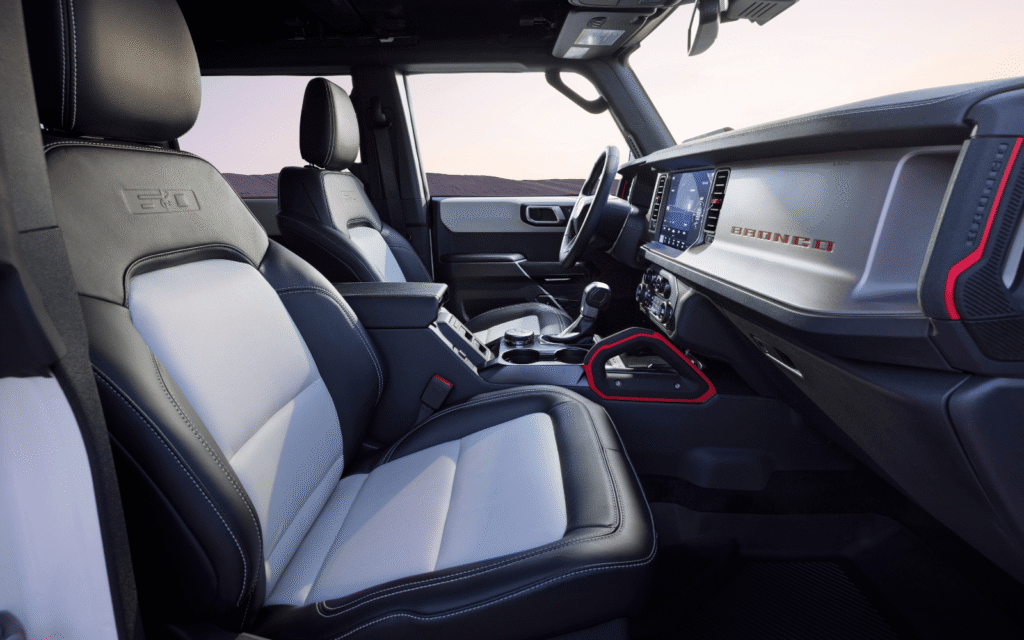
The Bronco’s cabin favors function over luxury. Large controls are easier to operate while wearing gloves, while available rubberized flooring and drain plugs suit muddy or wet trips.
The dashboard has attachment points for compatible phones, cameras, or navigation devices. Available overhead auxiliary switches simplify the installation of lights, air compressors, and other accessories.
Standard and available features include:
- 12-inch digital instrument cluster
- 12-inch SYNC 4 touchscreen
- Wireless Apple CarPlay and Android Auto
- Voice recognition
- Ford Power-Up software updates
- Available connected navigation
- Available wireless phone charging
- Available B&O audio system
- Available 360-degree camera
- Available front trail camera
- Available heated front seats
- Available heated steering wheel
- Available dual-zone automatic climate control
- Available adaptive cruise control
- Available marine-grade vinyl upholstery
- Washout flooring with drain plugs
- Factory auxiliary switches
- MOLLE-compatible seatback storage
Front-seat space is generous. The driving position is upright, and the Bronco’s boxy body makes its corners relatively easy to judge.
Four-door models provide acceptable rear space for adults. Two-door models have adequate rear legroom, but accessing the rear seats requires folding and moving the front seats.
Interior plastics are selected partly for durability and easy cleaning. Buyers expecting a luxury cabin may find the materials disappointing in expensive configurations.
Dimensions, Cargo, and Practicality
| Dimension | Bronco 2-Door | Bronco 4-Door |
| Length | Approximately 173.7 in. | Approximately 189.4–189.9 in. |
| Wheelbase | 100.4 in. | 116.1 in. |
| Front legroom | 43.1 in. | 43.1 in. |
| Rear legroom | 35.7 in. | 36.3 in. |
| Seating capacity | 4 | 5 |
| Cargo space behind rear seats | 20.6 cu. ft. | Up to 38.3 cu. ft. |
| Maximum cargo capacity | 52.0 cu. ft. | Up to 83.0 cu. ft. |
Cargo measurements vary by roof type and trim. Ford lists four-door models with approximately 33.3 to 38.3 cubic feet behind the rear seats and 72.8 to 83.0 cubic feet with the rear seats folded.
The four-door soft-top model provides the highest listed cargo volume. Hardtop hardware and the angle at which the rear seats fold can change usable space.
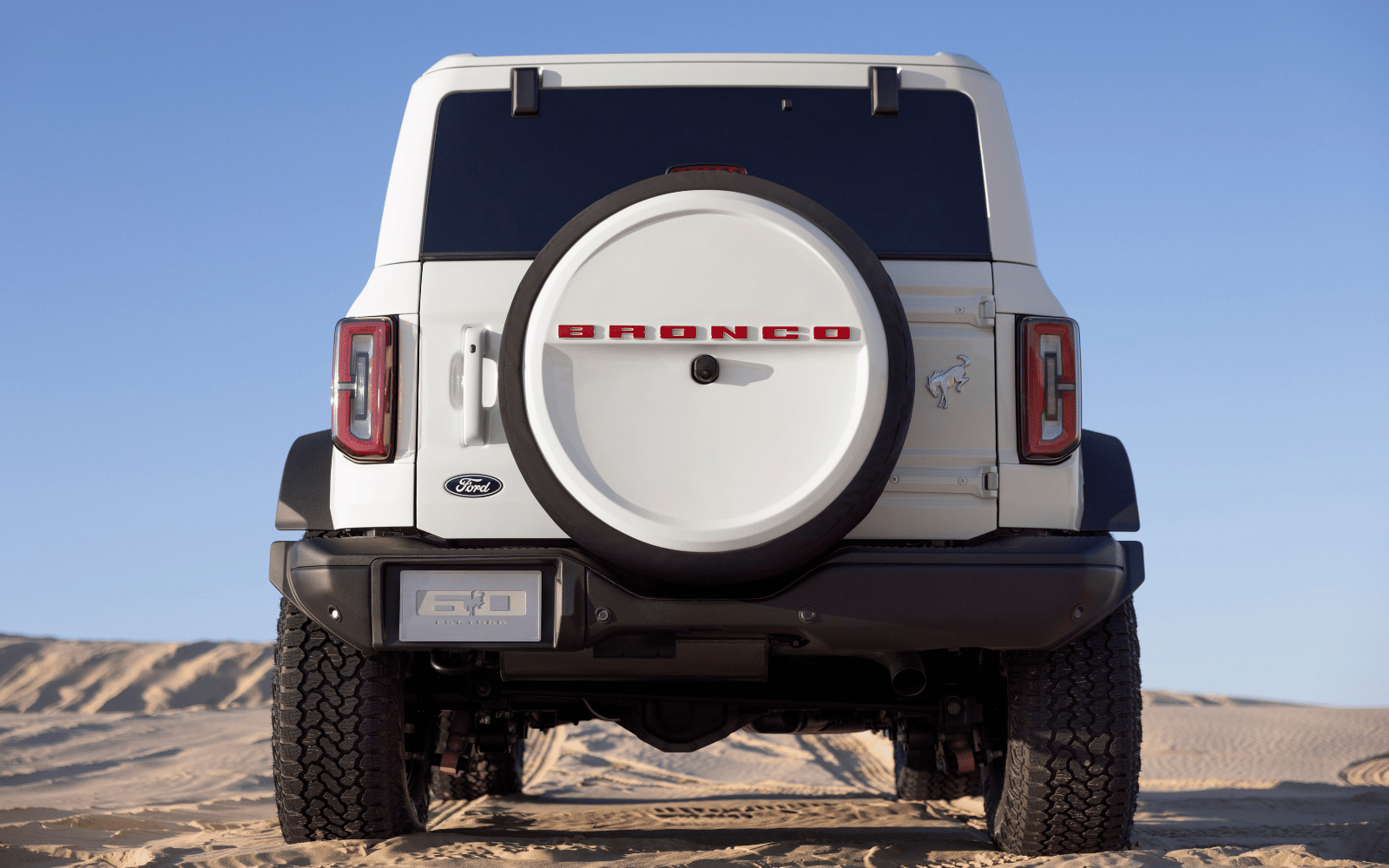
The side-hinged rear gate carries a full-size spare tire. It requires more room to open than a normal liftgate, which can be inconvenient when parked close to a wall or another vehicle.
The hardtop’s rear glass must be raised before the swing gate can open fully. Buyers should try the cargo door during a test drive to see whether it fits their parking and loading routine.
Removable Roof and Doors
The Bronco is one of the few modern SUVs that allows owners to remove both the doors and roof.
Two-door models use removable front roof panels and a removable rear hardtop section. Four-door models are available with a hardtop or folding soft top, depending on configuration.
The frameless doors can be removed with basic tools. Available storage bags help protect them, and some four-door configurations can carry the removed doors inside the vehicle.
Advantages include:
- Open-air driving
- Better visibility on technical trails
- Multiple hardtop and soft-top choices
- Body-mounted mirrors that remain in place
- Easy personalization
Trade-offs include:
- More wind noise
- More road noise
- Potential water drips after rain or washing
- Storage requirements for removed panels
- Additional time needed for removal and installation
- Less insulation than a fixed-roof SUV
Exterior Design
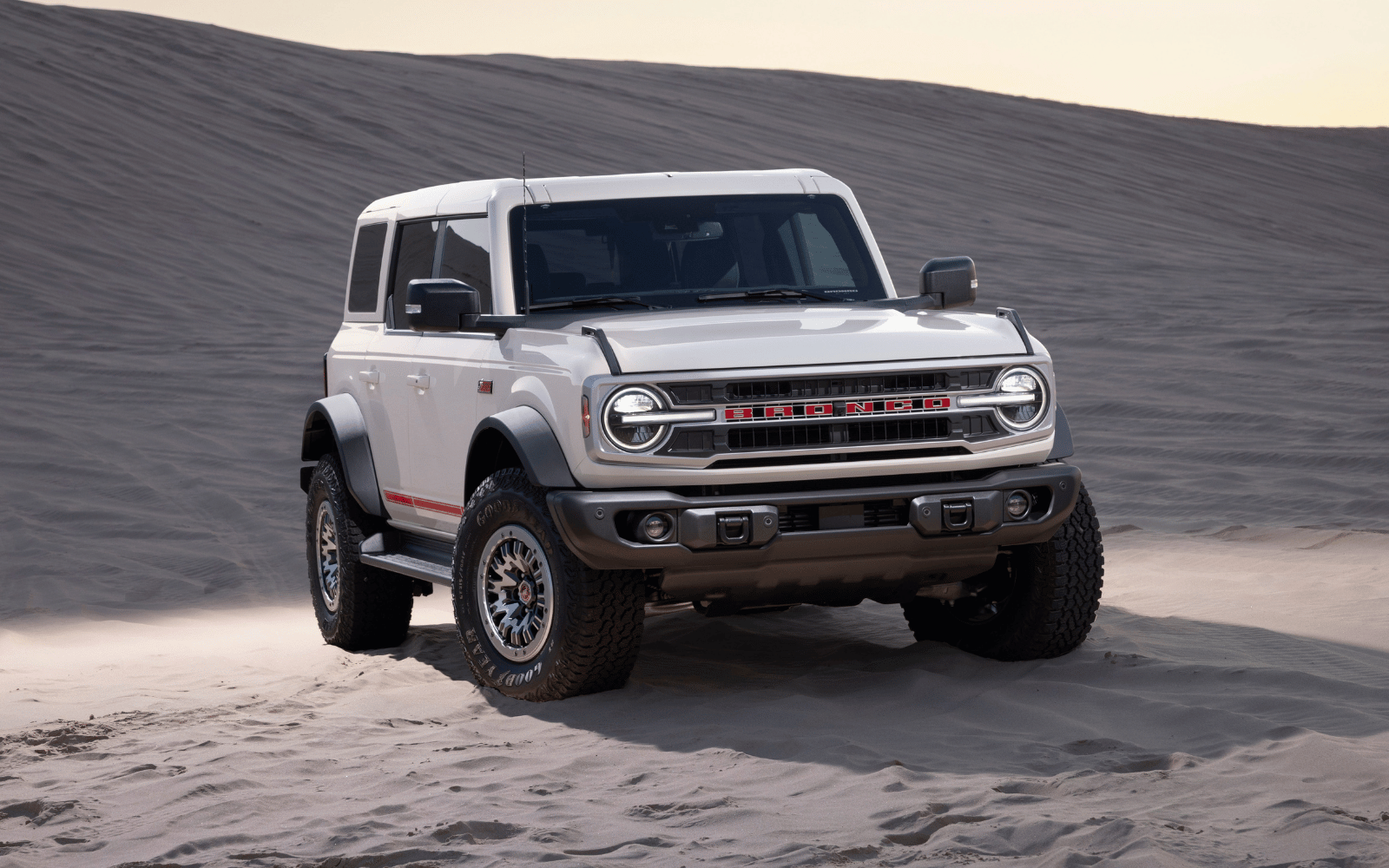
The Bronco has a square body, short overhangs, round headlights, upright windshield, and rear-mounted spare tire. Its design references older Broncos without copying one specific generation.
Base and Big Bend models use simpler trim and smaller standard tires. Outer Banks models add more body-color exterior pieces and street-focused styling.
Badlands models have more visible off-road hardware, including rock rails, bash plates, tow hooks, and wider fender flares when fitted with the Sasquatch Package.
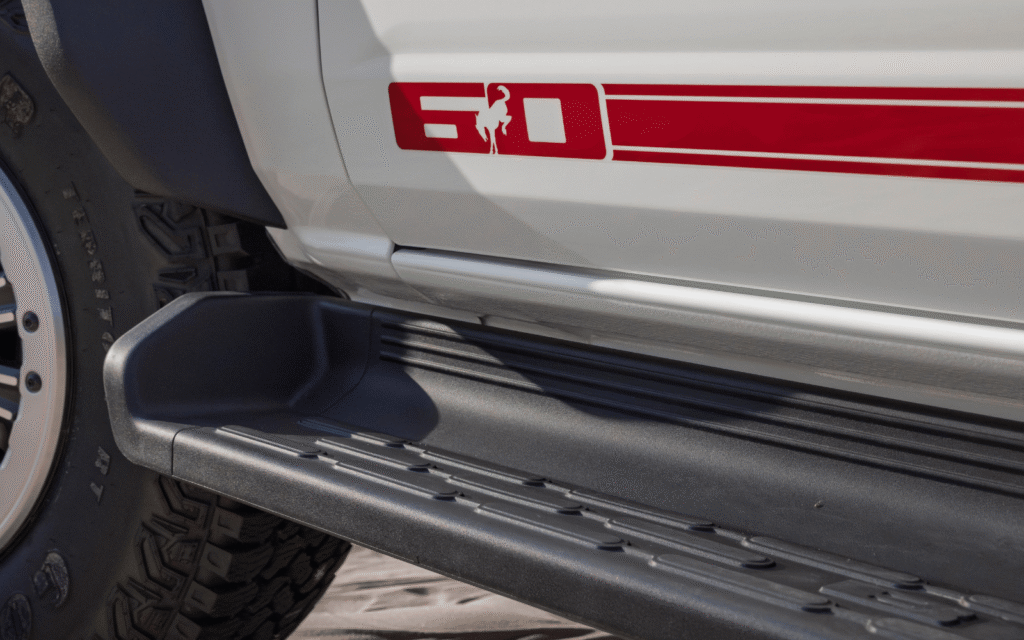
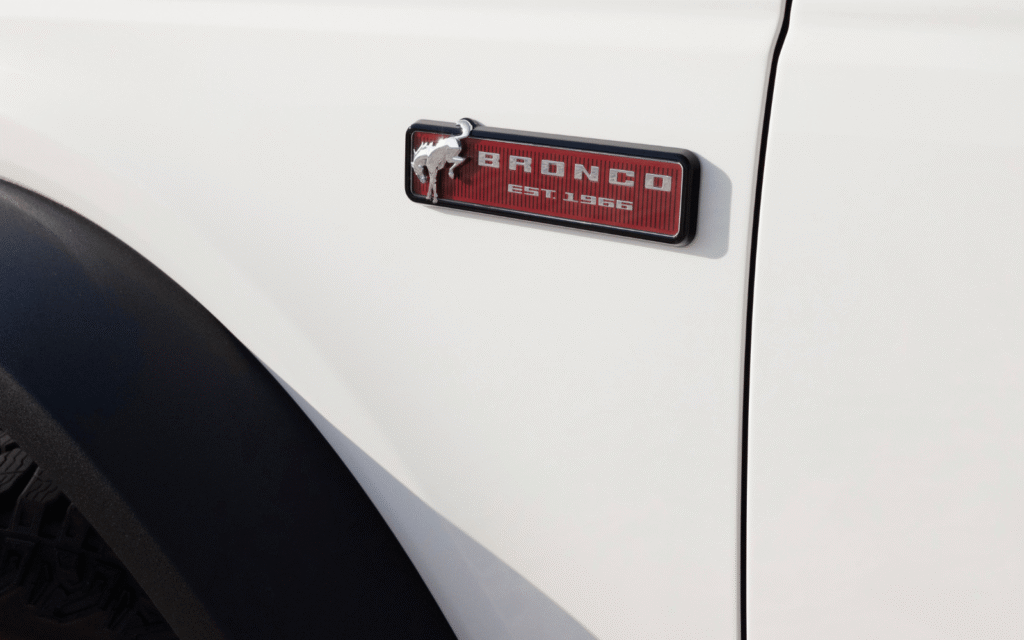
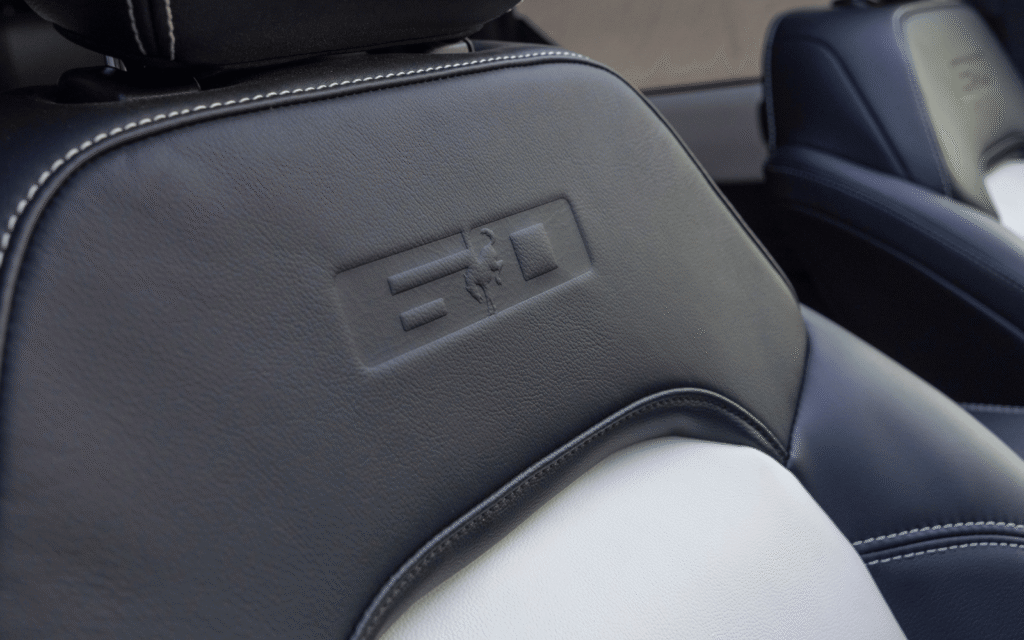
The Heritage Edition uses an Oxford White-painted roof, white grille, retro graphics, and plaid interior details.
The Stroppe Edition uses a Baja-inspired color scheme with Code Orange details, unique graphics, specialized wheels, and HOSS 3.0 suspension.
The Raptor has a much wider body, marker lights, large fender flares, heavy-duty bash plates, reinforced rock rails, and 37-inch tires.
Safety Features and Ratings
Standard and available safety features include:
- Pre-Collision Assist with Automatic Emergency Braking
- Forward-collision warning
- Pedestrian detection
- Automatic high beams
- Rearview camera
- Blind Spot Information System
- Rear Cross-Traffic Alert
- Lane-Keeping System
- Adaptive cruise control
- Evasive Steering Assist
- Rear parking sensors
- 360-degree camera
- Trail camera
- Front, side, and curtain airbags
- AdvanceTrac stability control with Roll Stability Control
- Trailer-sway control
The 2026 four-door Bronco received Good ratings in the IIHS driver- and passenger-side small-overlap front tests and the updated side-impact test.
It received a Marginal rating in the updated moderate-overlap front test. Driver protection was rated Good, but rear-passenger measurements included an Acceptable head and neck result and a Marginal chest result.
IIHS also rated the Bronco’s available headlight systems Marginal. Vehicle-to-vehicle front crash prevention received an Acceptable rating, while pedestrian front crash prevention received a Marginal rating.
See the complete IIHS Bronco safety results for the tested configurations and scoring details.
The two-door and four-door Bronco should not automatically be assumed to have identical ratings. Buyers should check the exact body style through NHTSA before purchase.
Reliability, Warranty, and Ownership
The current Bronco has been sold since the 2021 model year. Its powertrains share components with other Ford trucks and SUVs, but the vehicle’s removable body panels, advanced four-wheel-drive systems, turbocharged engines, and off-road electronics add complexity.
Ownership cost depends heavily on the configuration and how the vehicle is driven.
| Coverage | Length |
| Basic warranty | 3 years / 36,000 miles |
| Powertrain warranty | 5 years / 60,000 miles |
| Safety-restraint coverage | 5 years / 60,000 miles |
| Corrosion-perforation coverage | 5 years / unlimited miles |
| Roadside assistance | 5 years / 60,000 miles |
| Complimentary scheduled maintenance | Not included |
Prospective owners should budget for:
- Large off-road tire replacement
- Wheel alignment after trail use
- Brake wear
- Differential and transfer-case fluid changes
- Underbody inspections
- Turbocharged-engine maintenance
- Windshield damage
- Hardtop and door-seal care
- Roof-panel storage
- Increased fuel use with 35- or 37-inch tires
- Higher insurance costs on Raptor models
Inspect skid plates, suspension parts, wheels, tires, steering components, recovery points, and the frame when buying a used Bronco. Modified vehicles require extra care because lifts, oversized tires, tuning, and aftermarket accessories can affect drivability and warranty claims.
Check the VIN for open recalls before purchasing any new or used example.
Pros and Cons
What We Like
- Serious off-road ability across the lineup
- Standard four-wheel drive
- Two-door and four-door body choices
- Available seven-speed manual
- Strong 2.7-liter V6
- High-performance Raptor model
- Removable doors and roof panels
- Large standard touchscreen
- Wireless Apple CarPlay and Android Auto
- Useful four-door cargo capacity
- Factory accessory switches
- Washout-capable interior available
- Sasquatch Package offered on lower trims
- Good small-overlap and side-impact IIHS results
- Large owner and aftermarket community
What We Don’t Like
- Poor fuel economy
- Wind and road noise at highway speeds
- Options raise the price quickly
- V6 cannot be paired with the manual
- Two-door rear access is awkward
- Swing gate needs considerable space
- Rear visibility is limited by the spare tire
- Some expensive trims still use basic cabin plastics
- 35- and 37-inch tires cost more to replace
- Marginal updated IIHS moderate-overlap rating
- Marginal IIHS headlight and pedestrian-prevention results
- Raptor is difficult to place on narrow roads
- No hybrid model currently offered
Competitors
The Bronco competes with off-road SUVs and adventure-focused trucks:
- Jeep Wrangler: The Bronco’s closest rival. It offers two- and four-door bodies, removable doors and roof panels, strong trail hardware, and a wider range of powertrains.
- Toyota 4Runner: More traditional and less open-air focused, but practical, capable, and well suited to long-term ownership.
- Land Rover Defender: More refined and luxurious, with strong off-road technology, but substantially more expensive in comparable configurations.
- Jeep Grand Cherokee: Quieter and more comfortable on paved roads, but less configurable for open-air trail driving.
- Toyota Land Cruiser: Provides hybrid power, a practical four-door cabin, and strong off-road hardware, but no removable doors or roof.
- Lexus GX: More luxurious and better suited to long-distance travel, with a higher price and fewer open-air features.
- Ford Ranger Raptor: Offers strong high-speed off-road ability with a pickup bed, but has a different passenger and cargo layout.
- Chevrolet Colorado ZR2: A capable off-road pickup with useful bed space, although it cannot match the Bronco’s removable body panels.
The Ford Bronco Sport is a better choice for drivers who like the Bronco name and styling but do not need low-range four-wheel drive or removable doors.
Related Content
Before financing a Bronco, read how car financing works and compare dealer vs. bank car financing.
You can also estimate affordability with our guide on how to calculate a monthly car payment and learn how to get the best car loan rate.
Used-Bronco shoppers should review how to inspect a used car before buying and confirm whether off-road modifications were professionally installed.
Should You Buy the Ford Bronco?
Buy the Bronco if you want a real off-road SUV with removable doors, an available manual transmission, useful factory trail equipment, and enough daily practicality in four-door form.
Choose the Base if you want the lowest price and plan to build the vehicle around your own tire, suspension, and accessory choices.
Choose the Big Bend if you want the best balance of price and everyday features. Add the Sasquatch Package if serious off-road driving is part of the plan.
Choose the Outer Banks if the Bronco will spend most of its time on paved roads and you value comfort, appearance, and technology more than advanced rock-crawling equipment.
Choose the Badlands if you regularly drive technical trails. Its front stabilizer-bar disconnect, Bilstein dampers, bash plates, terrain modes, and available locking differentials give it the strongest capability-to-price case.
Choose the Heritage Edition for its retro styling rather than a major mechanical advantage over a properly equipped Big Bend or Badlands.
Choose the Stroppe Edition if you want a factory Baja-inspired special edition and accept its much higher price.
Choose the Raptor if you want extreme factory off-road performance, 37-inch tires, and a 418-hp engine. It is too wide, expensive, and inefficient to be the sensible Bronco for most buyers.
Skip the Bronco if quiet highway driving, low fuel costs, easy rear access, a refined luxury interior, or strong crash-test performance in every category matters more than off-road ability.
FAQs
How much does the Ford Bronco cost?
The 2026 Ford Bronco starts at $40,795 for the Base. The Big Bend starts at $41,790, the Badlands at $49,385, and the Bronco Raptor at $80,990 before destination and other charges.
Is the Ford Bronco available with two doors?
Yes. Selected trims are available with two doors. Other models are offered only with four doors, so buyers should check current configuration availability.
How many people can the Ford Bronco seat?
Two-door Broncos seat four people. Four-door models seat five.
What engine does the Ford Bronco have?
The standard engine is a 300-hp turbocharged 2.3-liter four-cylinder. A 330-hp twin-turbocharged 2.7-liter V6 is available, while the Raptor uses a 418-hp 3.0-liter V6.
Does the Ford Bronco have a manual transmission?
Yes. A seven-speed manual is available with the 2.3-liter four-cylinder on selected trims. The 2.7-liter and 3.0-liter V6 engines use a ten-speed automatic.
Is every Ford Bronco four-wheel drive?
Yes. Every full-size Bronco uses four-wheel drive. The exact transfer case, axle gearing, and locking-differential equipment vary by trim and package.
What is the Sasquatch Package?
The Sasquatch Package adds 35-inch tires, beadlock-capable wheels, locking front and rear differentials, shorter gearing, increased ground clearance, wider fender flares, and upgraded suspension hardware.
How much can the Ford Bronco tow?
Most Bronco trims can tow up to 3,500 pounds when properly equipped. The Bronco Raptor can tow up to 4,500 pounds.
What fuel economy does the Ford Bronco get?
The most efficient configurations return up to approximately 20 mpg combined. Badlands, Sasquatch, Stroppe, and Raptor models consume more fuel because of their tires, gearing, weight, and off-road equipment.
Can the Bronco’s doors and roof be removed?
Yes. The doors and roof sections can be removed. The exact removal process and panel arrangement depend on body style and roof type.
How much ground clearance does the Bronco have?
Ground clearance ranges from approximately 8.3 inches on a standard model to 11.6 inches with selected Sasquatch configurations. The Bronco Raptor provides 13.1 inches.
How deep can a Ford Bronco drive through water?
Selected Bronco configurations can ford up to 33.5 inches of water. The Raptor is rated for up to 37 inches. Actual conditions, current, surface firmness, and entry speed still matter.
Is the Ford Bronco a good daily driver?
The four-door Bronco can work well as a daily vehicle. Buyers should accept more wind noise, lower fuel economy, and less polished road manners than they would get from a car-based crossover.
Is the Ford Bronco safe?
The four-door Bronco earned Good IIHS ratings in small-overlap and updated side testing. It received a Marginal rating in the updated moderate-overlap test, along with Marginal headlight and pedestrian front-crash-prevention ratings.
What is the difference between the Bronco and Bronco Sport?
The Bronco is a body-on-frame SUV with low-range four-wheel drive, removable doors, and removable roof panels. The Bronco Sport is a smaller unibody crossover designed more for daily use and light off-road driving.
Is the Bronco Raptor worth buying?
The Raptor is worth considering if you will use its 418-hp engine, long-travel suspension, reinforced chassis, and 37-inch tires. A Badlands is a better value for slower technical trails and normal road use.
Final Verdict
The Ford Bronco is one of the most capable and configurable off-road SUVs on sale. It gives buyers two body styles, three turbocharged engines, an available manual transmission, removable body panels, and a wide choice of factory trail hardware.
The four-door model is practical enough for daily use, while the two-door offers a shorter wheelbase and more traditional Bronco proportions. Buyers can start with a basic four-cylinder model, add the Sasquatch Package, move to the technical Badlands, or choose the extreme Raptor.
Its compromises are clear. Fuel economy is poor, highway noise is noticeable, packages are expensive, and the updated IIHS moderate-overlap result raises a rear-passenger concern.
Prices, specifications, safety ratings, fuel-economy figures, towing limits, and feature availability can change by body style, configuration, model year, and market.