
The Federal Reserve raised its target range for the federal funds rate by 0.25 percentage point on September 16, 2026, moving it to 3.75%–4.00%. The decision does not automatically add 0.25 percentage point to every car loan, but it can place upward pressure on borrowing costs at a time when vehicle prices and payments are already high.
Existing fixed-rate auto loans will not change because of the decision. People applying for a new loan or refinancing an existing balance may, however, encounter different offers as banks, credit unions and finance companies adjust their pricing.
The higher target range took effect through the Federal Reserve’s monetary-policy implementation beginning September 17. (Federal Reserve issues FOMC statement)
Car-market affordability before the rate increase
| Metric | August 2026 figure |
| Average new-vehicle transaction price | $50,089 |
| Typical new-vehicle payment | $770 per month |
| Median income required | 35.5 weeks |
| Affordability-index loan rate | 9.49% |
| Dealertrack average contract rate | 10.99% |
| Loans longer than 72 months | 31.3% |
| Negative-equity share | 57.4% |
| Average used-vehicle listing price | $27,239 |
These figures describe different parts of the market and should not be treated as one universal loan scenario.
What did the Federal Reserve change?
The Federal Open Market Committee voted unanimously to raise the federal funds target range from 3.50%–3.75% to 3.75%–4.00%. The Fed said inflation remained elevated and described the increase as supporting a return to its 2% inflation goal.
The federal funds rate governs overnight lending between financial institutions. It is not the interest rate shown on a dealership finance agreement. Changes to the Fed’s target can still move through the financial system and influence banks’ funding costs, market yields and other short-term borrowing rates. (Federal Reserve issues FOMC statement)
The effect on auto financing may be gradual, uneven or partly anticipated before the announcement. A lender could raise its rates by less than 0.25 percentage point, by more than that amount or not immediately change them at all.
See How to Calculate Monthly Car Payment
Will car-loan rates increase after the Fed hike?
Some auto-loan rates may increase, but a matching quarter-point increase is not guaranteed.
Lenders set auto-loan offers using several factors:
- Borrower credit score and credit history
- New or used vehicle status
- Loan term
- Down payment
- Loan-to-value ratio
- Vehicle age and mileage
- Lender funding costs
- Market competition
- Manufacturer financing incentives
Borrowers with strong credit may still qualify for promotional or below-market financing on selected new vehicles. Used-car borrowers and applicants with weaker credit typically face higher rates because lenders price in more risk.
The Fed’s decision is therefore one part of the financing environment, not a direct price change applied to every borrower.
How much could a quarter-point difference cost?
Consider a hypothetical $40,000 loan for 72 months with no fees:
| Illustrative APR | Estimated payment | Total interest |
| 9.49% | About $731 per month | About $12,617 |
| 9.74% | About $736 per month | About $12,978 |
| Difference | About $5 per month | About $361 |
This example shows only the mathematical effect of a 0.25-percentage-point difference. It does not predict how a particular lender will respond to the Fed’s decision.
A larger loan, longer term or greater rate increase would raise the total cost further. The monthly difference may appear small, but the additional interest accumulates throughout the loan.
New-vehicle prices were already above $50,000
Kelley Blue Book reported that the average US new-vehicle transaction price reached $50,089 in August, rising 0.5% from July and 1.9% from August 2025. Its accompanying affordability analysis rounded the figure to $50,090.
The typical new-vehicle payment increased to $770 per month, while purchasing the average vehicle required 35.5 weeks of median income, up slightly from 35.4 weeks in July.
The interest rate used in the Cox Automotive and Moody’s Analytics affordability calculation fell by two basis points in August to 9.49%. That figure represents an estimated rate for a 72-month fixed-rate loan and predates the September Fed decision. (Cox Automotive Inc.)
The September rate increase did not cause August’s high prices or payments. It arrived after those affordability pressures were already present.
New vs Used Car: Which Should You Buy First?
Why does Cox Automotive also report a 10.99% rate?
Cox Automotive reported an average contract rate of 10.99% in its August Dealertrack Credit Availability Index. That is different from the 9.49% rate used in the vehicle-affordability calculation.
The two figures should not be presented as contradictory:
- 9.49% is an estimated input designed to represent a 72-month fixed-rate loan in the affordability index.
- 10.99% is the average contract rate reported through a different Dealertrack credit dataset.
They measure different loan samples and serve different analytical purposes. Neither rate represents the offer every buyer should expect.
Longer loans are hiding some of the payment pressure
The share of auto loans longer than 72 months reached a record 31.3% in Cox Automotive’s dataset during August. The share involving negative equity increased to 57.4%.
Longer terms can reduce the required monthly payment by spreading the balance across more months. They also keep the borrower in debt longer and can significantly increase total interest.
Negative equity occurs when the amount owed on a trade-in is greater than the vehicle’s value. Rolling that unpaid balance into another loan means financing part of the previous vehicle alongside the replacement.
Cox found that auto-credit access improved in August, but much of the change came through longer terms, more negative equity and a higher subprime share—not cheaper borrowing. (Cox Automotive Inc.)
Used vehicles are not automatically an inexpensive alternative
Used vehicles generally cost less than new ones, but lower-priced inventory remains limited.
The average used-vehicle listing price reached $27,239 in August, an increase of 7% from a year earlier and the highest monthly average since December 2022. Vehicles priced below $15,000 had only 29 days of supply, compared with 44 days across the overall used market. (Cox Automotive Inc.)
Used-car interest rates can also exceed new-car rates because older vehicles represent greater collateral risk and do not usually receive subsidized manufacturer financing.
Buyers should compare the complete loan structure rather than assuming that the lower vehicle price will automatically create a better financing deal.
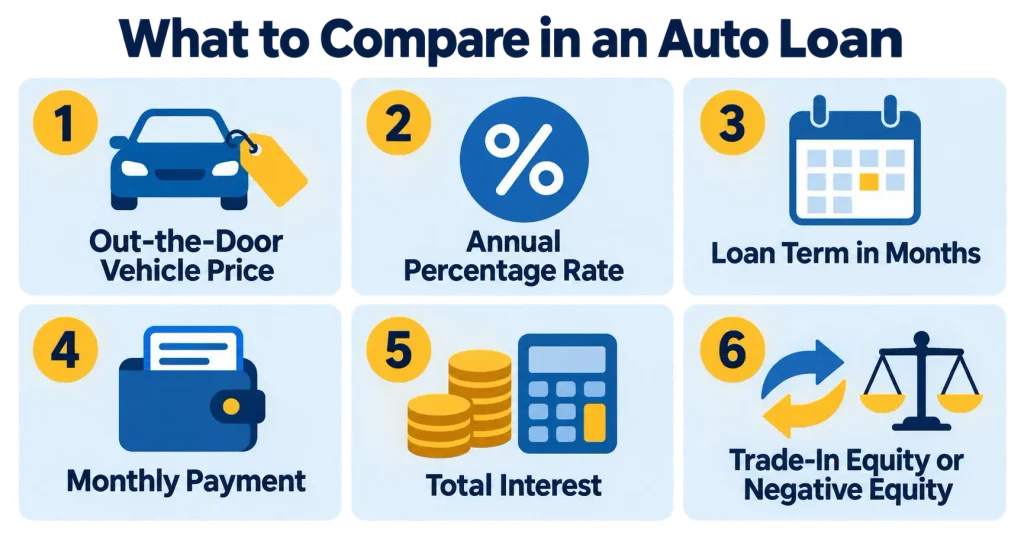
What should car buyers do now?
Compare APR, not only the advertised rate
APR accounts for the interest rate and certain financing charges. It provides a better comparison between offers than a promotional rate shown without its conditions.
Request financing from more than one lender
Compare dealership financing with banks, credit unions and online lenders. A preapproval can also establish a reference point before entering dealership negotiations.
Negotiate the out-the-door price first
Ask for the complete price, including taxes, registration, documentation charges, dealer-installed products and other fees. A lower monthly payment can hide a higher purchase price or longer term.
Compare total interest
Review the total of payments and finance charge on the loan disclosure. Extending the term may lower the payment while substantially increasing the amount paid over time.
Check the negative-equity amount separately
If a trade-in has an unpaid balance, ask the dealer to show its value, payoff amount and negative equity as separate figures. Avoid judging the deal only by the combined monthly payment.
Review manufacturer incentives carefully
A manufacturer may offer a choice between discounted financing and a cash rebate. Calculate both options because taking the lower APR may require giving up a valuable discount.
Explore Best Affordable Cars for Young Drivers
What the rate hike means for existing borrowers
A standard fixed-rate auto loan will retain the same interest rate and scheduled payment. The Federal Reserve’s action does not rewrite an existing fixed-rate contract.
The decision may matter if a borrower:
- Refinances the remaining balance
- Replaces the vehicle and applies for another loan
- Uses a variable-rate vehicle loan
- Trades in a vehicle with negative equity
Refinancing can still lower a payment or total interest if the borrower’s credit has improved or the original rate was unusually high. A longer refinance term can reduce the payment without producing meaningful savings, so the remaining interest and final payoff date must be compared.
What happens next?
The rate hike may take time to appear across lender offers, and other market forces could offset or amplify it. Treasury yields, lender competition, vehicle incentives and borrower credit conditions will continue influencing auto-loan pricing.
For shoppers, the immediate lesson is not that every loan will become exactly 0.25 percentage point more expensive. It is that expensive vehicles, high contract rates and longer loan terms leave little room for careless financing decisions.