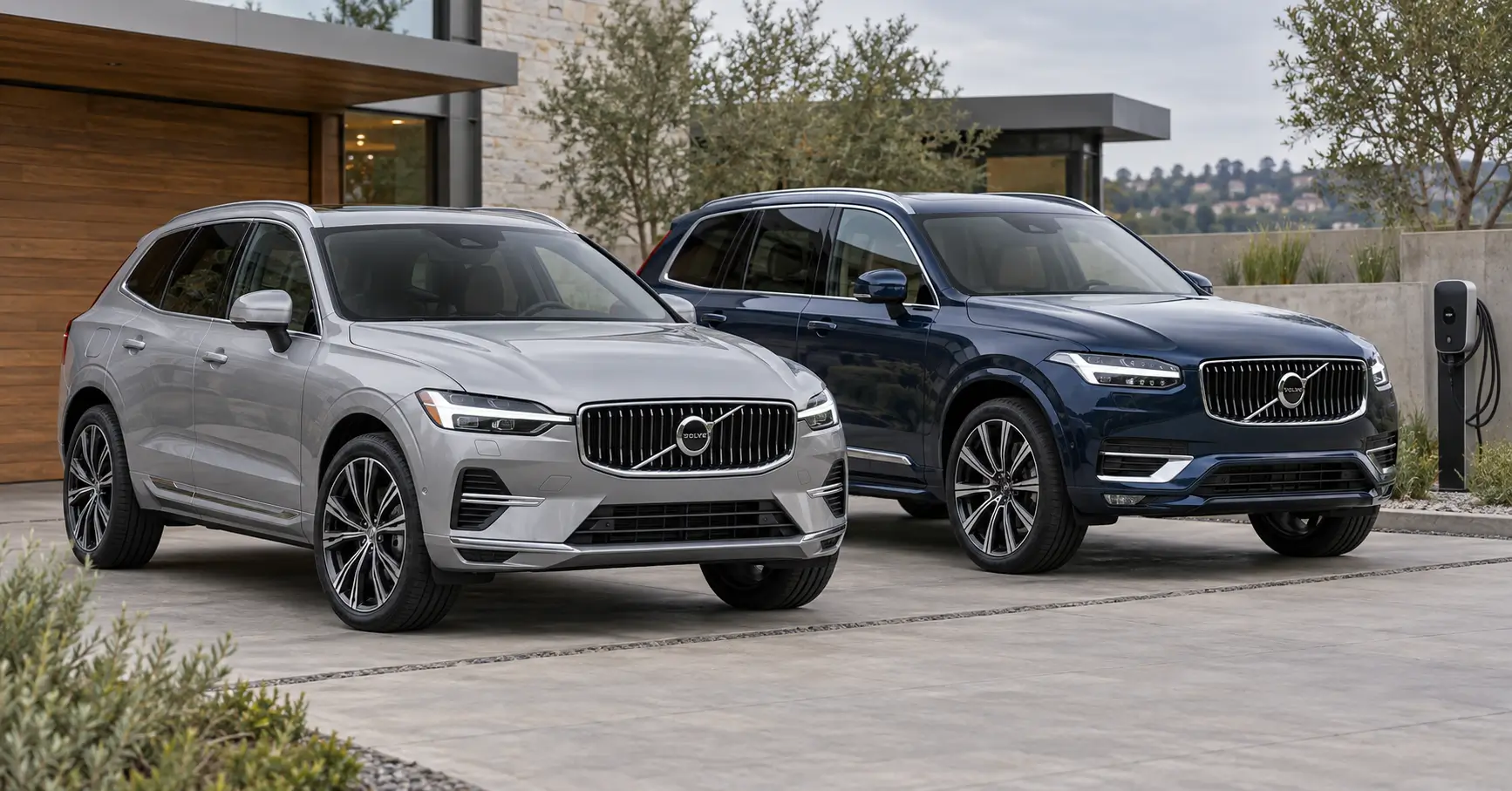
Volvo’s 2028 XC60 and XC90 T8 AWD plug-in hybrids promise more than twice the electric range of today’s models. The preliminary figures could let many owners handle routine driving without gasoline, but charging speed, final EPA ratings and US prices remain unknown.
Volvo is preparing long-range plug-in-hybrid versions of the XC60 and XC90 for the 2028 model year, with preliminary electric-range estimates that move both SUVs much closer to full-EV territory.
The 2028 Volvo XC60 T8 AWD Long Range Plug-in Hybrid targets up to 78 miles of electric driving. The larger, three-row XC90 version targets up to 73 miles. Volvo says both estimates are based on EPA testing standards, although neither figure is a finalized EPA rating.
The increases come from a larger floor-integrated battery and a stronger electric motor. Production is scheduled to begin in late fall 2026, with US customer deliveries expected in early 2027.
2028 Volvo XC60 and XC90 PHEV range comparison
The new estimates represent a major change from the current Volvo plug-in-hybrid lineup.
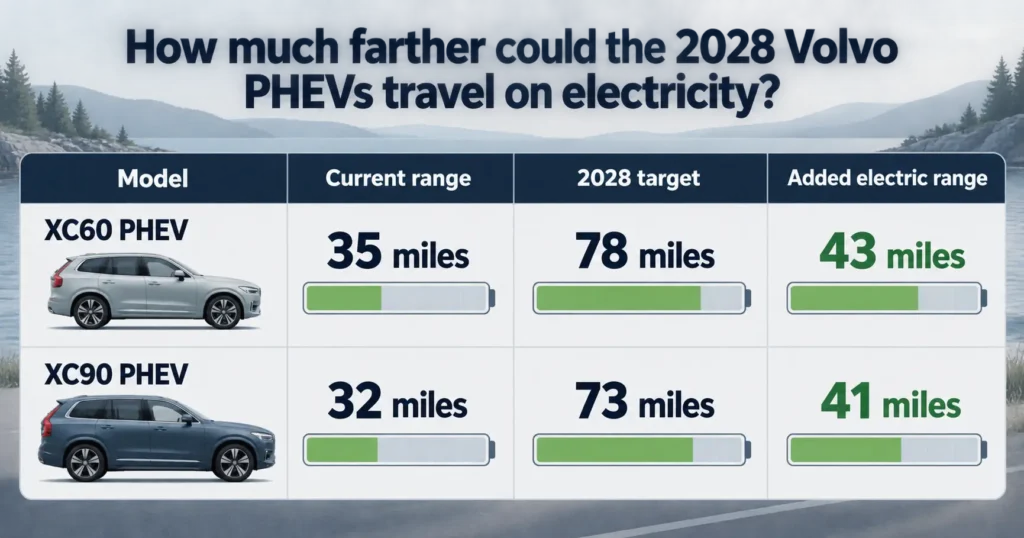
The current XC60 plug-in hybrid carries an EPA-estimated electric range of up to 35 miles. The current XC90 manages up to 32 miles.
That means the upcoming XC60 could travel more than twice as far before using gasoline. The XC90’s improvement is similarly large despite its greater size and three-row layout.
These are not final ratings, however. Volvo says range will vary with vehicle specification, battery and outdoor temperature, weather, elevation, speed and driving behavior. Wheel and tire choices could also affect the eventual EPA figures.
Could a 70-mile PHEV replace gasoline for daily driving?
For buyers who can charge regularly, 73 to 78 miles of electric range could cover commuting, school trips, shopping and other routine travel without starting the gasoline engine on many days.
Whether that happens in practice depends on how the SUV is used.
An owner who drives 30 miles per day and charges overnight could complete most routine trips on electricity. Someone who drives long highway distances, cannot charge at home or frequently tows may use the gasoline engine much more often.
Cold weather, higher speeds and cabin heating can also reduce electric range. The gasoline engine may start when the driver requests strong acceleration, the battery is depleted or the vehicle determines that engine assistance is needed.
The advantage over a full EV is that the trip does not end when the battery’s electric range is exhausted. The XC60 and XC90 continue operating as hybrids using their gasoline engines.
That flexibility makes the new models relevant for buyers who want electric driving during the week but do not want to depend on public charging during longer trips.
It also makes charging behavior critical. A plug-in hybrid carrying a large depleted battery may provide much less of the fuel-saving benefit buyers expect. Owners will need access to convenient home or workplace charging to get the most from the new powertrain.
How Volvo’s projected range compares with other luxury PHEVs
If Volvo’s preliminary figures are confirmed, both SUVs would exceed the electric ranges advertised for several current US-market luxury plug-in hybrids.
| Luxury plug-in-hybrid SUV | Electric range |
| 2028 Volvo XC60 T8 AWD | Up to 78 miles, preliminary |
| 2028 Volvo XC90 T8 AWD | Up to 73 miles, preliminary |
| 2026 Mercedes-Benz GLE 450e | 49 miles, EPA estimate |
| 2026 BMW X5 xDrive50e | Up to 38 miles |
| 2026 Lexus TX 550h+ | 33 miles, manufacturer estimate |
| Current Volvo XC60 T8 AWD | 35 miles, EPA estimate |
| Current Volvo XC90 T8 AWD | 32 miles, EPA estimate |
Mercedes-Benz lists 49 miles of EPA-estimated electric range for the 2026 GLE 450e, while BMW lists up to 38 miles for the 2026 X5 xDrive50e. Lexus projects 33 miles for the three-row TX 550h+.
The comparison is not final because Volvo’s figures still require EPA confirmation. Competing models may also receive updates before the 2028 Volvos reach dealerships.
Range alone does not establish which PHEV is the better purchase. Charging speed, passenger space, performance, towing capacity, price and fuel economy after the battery is depleted will all affect the ownership experience.
What changes on the 2028 Volvo XC60?
The XC60 receives a larger update than the XC90.
Exterior changes include a revised grille, front bumper, hood, front fenders, wheels, tailgate, rear bumper and rear lights. Volvo has also reworked its Thor’s Hammer LED headlight signature.
The cabin receives a new dashboard and door-panel design, revised trim and an 11.2-inch center display running Volvo’s latest infotainment interface.
Google Gemini replaces the previous Google Assistant experience. Volvo says drivers will be able to use everyday voice commands to plan trips, find stops, manage messages and access supported vehicle functions. Feature availability may depend on account setup, connectivity, subscriptions and user consent.
The updated XC60 also gets revised cameras, radar and other sensors supporting features such as:
- Automatic emergency braking
- Automatic emergency steering
- Lane-change assistance
- A 360-degree camera with 3D view
- Door-opening warnings for approaching cyclists
Exact standard and optional equipment for US trims has not been published.
What changes on the 2028 Volvo XC90?
The XC90 receives the same long-range T8 AWD plug-in-hybrid concept but fewer exterior changes. Volvo recently updated the SUV’s design and technology, so the 2028 announcement concentrates mainly on the new powertrain.
The XC90 remains the larger option, with three rows and configurations for six or seven occupants. It also receives Google Gemini through its Google-based infotainment system.
Volvo plans to continue selling mild-hybrid versions of both SUVs alongside the new long-range plug-in hybrids.
Battery capacity and charging speed remain key questions
Volvo’s US announcement confirms a larger-capacity, floor-mounted battery but does not state its gross capacity, usable capacity, maximum AC charging rate or whether either SUV will support DC fast charging.
The Verge reports a 41.2-kWh gross battery with 37.9 kWh usable in both vehicles. Volvo did not include those figures in its US announcement, so they should be treated as reported specifications until the company publishes final US technical data.
Charging speed may be as important as battery size. A battery capable of supporting nearly 80 miles of electric driving will take longer to refill unless Volvo also raises the onboard charging rate.
For reference, the current XC60 takes about five hours for a full charge under Volvo’s stated AC charging conditions. The current XC90 also takes approximately five hours at up to 6.4 kW AC. Those times should not be applied to the 2028 models because their batteries and charging hardware may differ.
Buyers should wait for the following specifications before comparing home-charging requirements:
- Usable battery capacity
- Maximum Level 2 AC charging rate
- Estimated charging time
- DC fast-charging availability
- Connector type
- Battery and hybrid-system warranty
- Fuel economy after electric range is depleted
Will the 2028 Volvo PHEVs qualify for a federal tax credit?
Buyers should not expect the former US federal New Clean Vehicle Credit to reduce the purchase price.
The IRS states that the Section 30D credit is available only for qualifying vehicles acquired on or before September 30, 2025. These Volvos are scheduled to reach customers in 2027, so they would not qualify under the federal consumer purchase-credit rules in effect at publication.
State, local and utility incentives may still be available. Eligibility can depend on location, household income, vehicle price, charging equipment and program funding. Buyers should check current requirements when the SUVs go on sale.
Federal policy could change before deliveries begin, but no future credit should be included in an affordability calculation unless a new law is enacted.
When will the 2028 XC60 and XC90 reach dealerships?
Volvo says production will begin later in fall 2026. US customer deliveries are scheduled to start in early 2027.
The automaker has not announced:
- US starting prices
- Trim-level pricing
- Standard equipment by trim
- Final EPA range
- EPA fuel economy
- Total gasoline-and-electric range
- Final power and torque
- Charging specifications
- Towing and payload ratings
Those missing figures make it too early to calculate whether the long-range versions will deliver better overall value than the current models or competing luxury SUVs.
Should buyers wait for the long-range models?
Buyers interested in an XC60 or XC90 plug-in hybrid should consider waiting if electric range is a priority and an early-2027 purchase fits their schedule.
The projected range increase is large enough to change how these vehicles could be used. A 73- or 78-mile battery range may let a household treat the SUV like an EV for routine driving while keeping gasoline available for longer trips.
Waiting makes less sense for buyers who need a vehicle immediately, lack dependable charging or expect the larger battery to carry a substantial price increase. Current Volvo PHEVs already offer strong combined output and may become more attractive if dealers discount them before the new models arrive.
The final decision will depend on price and charging performance. Until Volvo releases those details and the EPA publishes certified ratings, the headline range figures should be viewed as promising targets rather than guaranteed results.
2028 Volvo XC60 and XC90 PHEV Quick Facts
| Item | 2028 XC60 T8 AWD | 2028 XC90 T8 AWD |
| Powertrain | Long-range plug-in hybrid | Long-range plug-in hybrid |
| Drivetrain | All-wheel drive | All-wheel drive |
| Preliminary electric range | Up to 78 miles | Up to 73 miles |
| Current model’s electric range | Up to 35 miles | Up to 32 miles |
| Seating | Not yet confirmed for US trims | Six or seven expected |
| Production | Late fall 2026 | Late fall 2026 |
| US deliveries | Early 2027 | Early 2027 |
| Price | Not announced | Not announced |
| Final EPA rating | Pending | Pending |
| Official charging specifications | Not announced | Not announced |