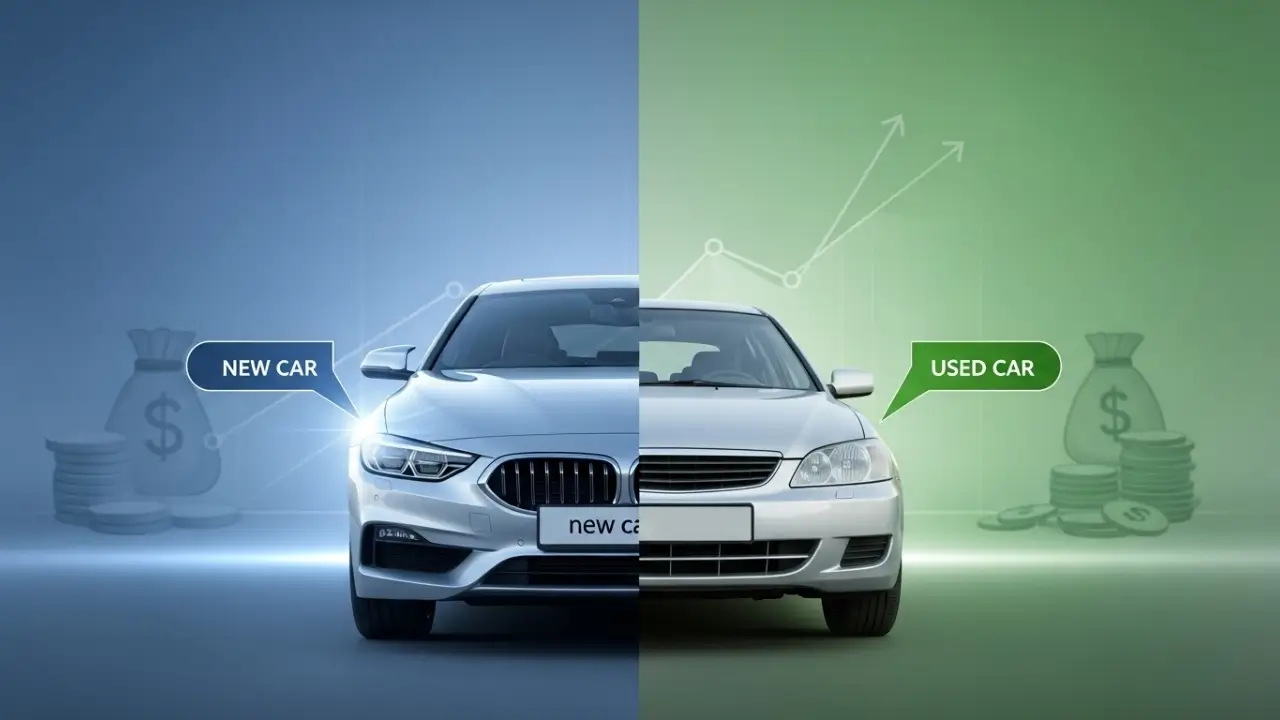
Choosing between a new vs used car is one of the first major decisions a first-time buyer must make. A new vehicle offers warranty protection, the latest safety technology, and a clean ownership history. A used vehicle normally costs less and avoids much of the steep depreciation that occurs during a car’s early years.
Neither option is automatically better.
The right choice depends on your budget, credit profile, annual mileage, tolerance for repair risk, and how long you plan to keep the vehicle. A well-priced new car with promotional financing may cost less over time than a lightly used vehicle financed at a high interest rate. On the other hand, a carefully inspected three- to five-year-old car can provide far better value than stretching your budget for a new model.
Quick Verdict
Buy a new car when:
- You can afford the full ownership cost without financial strain.
- You want full manufacturer warranty coverage.
- Current safety and driver-assistance systems matter.
- You qualify for competitive promotional financing.
- You plan to keep the vehicle for many years.
- Predictable maintenance is a priority.
Buy a used car when:
- Keeping the purchase price low is your main goal.
- You want to avoid the steepest early depreciation.
- You can pay cash or borrow a smaller amount.
- You are willing to inspect the vehicle carefully.
- You can maintain an emergency repair fund.
- You want a higher trim or larger vehicle for the same budget.
Best choice for most first-time buyers:
A reliable three- to five-year-old used car with a clean title, complete maintenance records, modern safety equipment, and a successful independent inspection.
Best choice for maximum predictability:
An affordable new car with a strong warranty, low insurance quote, and favorable financing terms.
New vs Used Car
| Buying Factor | New Car | Used Car |
| Purchase price | Higher | Usually lower |
| Depreciation | Fastest during early ownership | Slower after initial decline |
| Warranty | Full manufacturer coverage | May be limited or expired |
| Repair risk | Lower initially | Depends on age and condition |
| Financing rate | Often lower | Often higher |
| Insurance | May cost more | May cost less |
| Safety technology | Latest systems available | Varies by model year and trim |
| Vehicle history | No previous owner | Must be researched |
| Model choice | Choose trim, color, and options | Limited to available inventory |
| Maintenance history | Starts with buyer | May be incomplete |
| Loan amount | Usually larger | Usually smaller |
| Resale loss | Greater in early years | Previous owner absorbed part of it |
Advantages of Buying a New Car First
Full Manufacturer Warranty
A new vehicle normally includes manufacturer coverage for defects during a set period or mileage limit. Powertrain coverage may last longer than the main vehicle warranty.
This reduces the risk of receiving a large repair bill soon after purchase. Routine maintenance, tires, brake wear, accidental damage, and other exclusions still remain the owner’s responsibility.
Warranty protection is useful for a first-time buyer who has limited savings and cannot comfortably handle an unexpected engine, transmission, electrical, or air-conditioning repair.
Coverage varies by manufacturer, so compare:
- Basic warranty period
- Powertrain warranty
- Hybrid or EV battery warranty
- Roadside assistance
- Included maintenance
- Corrosion coverage
- Warranty transfer rules
Do not assume that every new vehicle provides the same protection.
No Previous Ownership History
A new car has no previous owner, accident history, neglected maintenance, hidden flood exposure, or questionable repair work.
The buyer controls maintenance from the start and can keep complete service records. This makes the vehicle’s condition easier to manage over the long term.
A new vehicle can still have transport damage, manufacturing defects, recalls, or dealer-installed accessories. Inspect it before delivery and check that every agreed feature is present.
Latest Safety Technology
New cars are more likely to include current driver-assistance systems such as:
- Automatic emergency braking
- Forward-collision warning
- Lane-departure warning
- Lane-keeping assistance
- Blind-spot monitoring
- Rear cross-traffic alert
- Adaptive cruise control
- Driver-attention monitoring
- Improved reversing cameras
Availability differs by trim. Some entry-level versions may not include every advertised feature.
A newer vehicle may be worth the additional cost when current crash protection and active safety systems are high priorities.
Lower Initial Repair Risk
A new car should require little beyond scheduled maintenance during its early ownership period.
This does not make it maintenance-free. Owners still need to budget for:
- Oil changes
- Tire rotation
- Filters
- Wiper blades
- Damage
- Insurance deductibles
- Registration
- Fuel or charging
The main benefit is greater predictability rather than zero operating cost.
Better Financing Opportunities
Manufacturers sometimes offer lower interest rates, cash incentives, or special programs on selected new vehicles. Buyers with strong credit may receive financing terms that are unavailable on used cars.
A lower interest rate can reduce the difference between new and used ownership costs. However, a promotional rate does not automatically make the deal affordable.
Compare:
- Vehicle price
- Down payment
- APR
- Loan term
- Monthly payment
- Amount financed
- Total finance charge
- Total of all payments
Some offers require choosing between promotional financing and a cash rebate. Calculate both options before deciding.
Ability to Choose the Exact Vehicle
Buying new provides more control over:
- Exterior color
- Interior color
- Trim level
- Engine
- Drivetrain
- Safety features
- Comfort options
- Wheel size
This can help you avoid paying for features you do not need. In practice, dealer inventory may still limit your choices unless you order the vehicle.
Disadvantages of Buying a New Car
Higher Purchase Price
The most obvious disadvantage is cost. A higher purchase price can mean:
- Larger down payment
- Higher monthly payment
- More interest
- Higher sales tax
- Greater risk of negative equity
- Less money available for savings
A buyer should not select a new car simply because a lender approves the loan.
Loan approval shows what the lender is willing to provide. It does not determine what fits comfortably within your budget.
Faster Depreciation
Depreciation is the loss in a vehicle’s market value over time. New cars normally experience their largest value decline during the first years of ownership.
This matters most when the owner:
- Makes a small down payment
- Uses a long loan term
- Drives high annual mileage
- Trades frequently
- Buys a model with weak resale demand
A buyer can owe more than the car is worth when the loan balance falls more slowly than its market value. This is known as negative equity.
Depreciation is less damaging when you buy a suitable car, keep it for many years, maintain it properly, and continue driving after the loan is repaid.
Potentially Higher Insurance Costs
A new car may cost more to repair or replace, which can increase insurance premiums. Lenders normally require collision and comprehensive coverage while the vehicle is financed.
Insurance pricing depends on far more than vehicle age. Driver history, location, trim, engine power, repair costs, theft data, mileage, deductible, and coverage limits all matter.
Get insurance quotes before choosing between a new and used version of the same model.
Pressure to Buy More Features
New-car buyers can easily move from an affordable base trim to an expensive version with:
- Larger wheels
- Premium audio
- Sunroof
- Leather seating
- Appearance packages
- More powerful engine
- Advanced parking technology
Optional features may improve the car but can also increase the purchase price, interest cost, insurance, tire expense, and repair cost.
Buy features that improve your regular use, not those that only look appealing in the showroom.
Advantages of Buying a Used Car First
Lower Purchase Price
A used vehicle usually costs less than an equivalent new model. This allows a first-time buyer to:
- Make a smaller down payment
- Borrow less
- Choose a shorter loan
- Reduce the monthly payment
- Pay cash
- Keep more savings available
A lower price can also provide access to a larger vehicle, higher trim, or stronger engine within the same budget.
Do not assume that every used car is a bargain. Compare its price with a new equivalent after including incentives, financing, warranty coverage, and expected repairs.
Slower Depreciation
The first owner normally absorbs the steepest part of the car’s early value loss. A used buyer purchases the vehicle after some of that depreciation has already occurred.
The used car will continue losing value, but the dollar amount may be smaller than the loss on a brand-new version.
This is one reason a three- to five-year-old vehicle can work well for first-time buyers. It may still provide current safety technology while costing considerably less than a new car.
Smaller Loan and Less Financial Exposure
Borrowing less can reduce:
- Monthly payment
- Total interest
- Negative-equity risk
- Financial pressure
- Time required to repay the loan
A lower payment also leaves more room for insurance, maintenance, repairs, and emergency savings.
The used-car loan rate may be higher, so compare the complete financing cost rather than the rate alone.
Potentially Lower Insurance Premium
A lower vehicle value may reduce some insurance costs. Buyers who own an inexpensive used car without a loan may also have more flexibility in choosing optional collision and comprehensive coverage.
Dropping coverage is not always wise. Consider whether you could afford to replace the vehicle after theft, severe weather, or an at-fault crash.
Liability coverage remains required in most situations, and state rules differ.
More Car for the Same Money
A buyer deciding between a new subcompact car and a used compact or midsize model may receive more:
- Passenger space
- Cargo room
- Comfort
- Engine power
- Equipment
- Highway stability
The newer but smaller car may still be the better choice when fuel economy, warranty coverage, and safety technology matter more than size.
Disadvantages of Buying a Used Car
Greater Repair and Maintenance Risk
A used car may need tires, brakes, a battery, suspension work, fluid services, or other repairs soon after purchase.
The risk depends on:
- Model reliability
- Age
- Mileage
- Maintenance history
- Previous use
- Climate exposure
- Accident history
- Current condition
A low purchase price can lose its appeal when the vehicle immediately requires several thousand dollars of work.
Budget for both the purchase and the likely first-year maintenance.
Unknown Vehicle History
Not every accident, repair, or service appears on a history report.
A used car may have:
- Unreported collision repairs
- Flood exposure
- Odometer problems
- Missed maintenance
- Heavy commercial use
- Poor-quality replacement parts
- Electrical modifications
- Persistent mechanical faults
Review the title, obtain a vehicle history report, check for recalls, study maintenance records, and arrange an independent inspection.
No single check is enough by itself.
Limited or No Warranty
Some used cars are sold with remaining factory coverage. Others include a dealer warranty, certified pre-owned protection, or no warranty at all.
A vehicle sold “as is” may leave the buyer responsible for repairs after the purchase, subject to state law and the written agreement.
Read the FTC Buyers Guide displayed on a dealer’s used vehicle. Make sure any promised warranty appears in the final contract.
Higher Financing Rates
Used-car financing often carries a higher APR than new-car financing. Older vehicles may also face lender restrictions based on mileage, age, price, or loan term.
A lower purchase price can still produce a high total cost when paired with:
- High APR
- Long loan
- Small down payment
- Dealer add-ons
- Poor credit
- Expensive service contract
Secure loan offers from banks or credit unions before visiting the dealership.
Fewer Choices
Used inventory is limited to vehicles currently available. Finding the correct combination of model, condition, mileage, trim, color, and price can take time.
Compromising on color is normally harmless. Compromising on title status, mechanical condition, safety equipment, or maintenance history is not.
How Depreciation Changes the Decision
Depreciation should be treated as an ownership cost even though it does not appear as a monthly bill.
Suppose a new vehicle costs $30,000 and loses $9,000 of value during its first two years. A buyer purchasing it after that decline may receive much of the same functionality for approximately $21,000, depending on market conditions, mileage, and condition.
However, the used buyer may face:
- Higher loan APR
- Reduced warranty coverage
- Earlier tire replacement
- Earlier brake service
- Greater repair risk
The correct comparison is not simply $30,000 new versus $21,000 used.
Compare the expected total cost over the time you plan to own the car:
Purchase price + financing + insurance + fuel + maintenance + repairs − resale value
A new car can make sense when you keep it well beyond the initial depreciation period. A used car often makes more sense when minimizing the initial financial commitment is the priority.
How Financing Affects New vs Used Value
Financing can change which option costs less.
Example A: New Car With Low-Rate Financing
A new vehicle may have:
- Higher purchase price
- Lower APR
- Full warranty
- Lower early repair risk
This can narrow the total-cost gap, especially if the buyer qualifies for manufacturer-supported financing.
Example B: Used Car With High-Rate Financing
A used vehicle may have:
- Lower purchase price
- Higher APR
- Shorter warranty
- Immediate maintenance needs
Interest and repairs can consume part of the purchase-price savings.
Always compare written loan offers using the same:
- Down payment
- Loan term
- Taxes and fees
- Optional products
A low monthly payment created by a longer loan is not a saving.
Best Used-Car Age
For many buyers, the most practical range is three to five years old.
Cars in this range may offer:
- Lower price than new
- Reduced depreciation
- Modern safety systems
- Reasonable mileage
- Remaining warranty on some models
- Better parts availability
- Current infotainment features
A six- to ten-year-old vehicle can provide better value for a cash buyer, but condition and maintenance become more important.
Mileage should not be judged alone. A higher-mileage highway car with complete service records may be better than a low-mileage vehicle that was neglected, damaged, or driven only on short trips.
When You Should Buy New
A new car is the stronger first purchase when:
- You can afford it without using your emergency savings.
- The monthly ownership cost fits comfortably.
- You plan to keep it for eight years or longer.
- You qualify for a competitive interest rate.
- Reliability and warranty predictability matter most.
- Your chosen used version is only slightly cheaper.
- Current safety systems are essential.
- You need a specific configuration that is difficult to find used.
New does not mean you should buy the most expensive vehicle you qualify for. Entry and mid-level trims often provide the best balance.
When You Should Buy Used
A used car is the stronger first purchase when:
- You have a limited budget.
- You want a smaller loan.
- You can pay cash without emptying your savings.
- You can fund an independent inspection.
- You can keep money available for repairs.
- You want to avoid the steepest depreciation.
- You are comfortable reviewing vehicle history and condition.
- You find a well-maintained car with a clean title and fair price.
Used cars reward careful research. A rushed purchase based on price alone can create more risk than savings.
Final Buying Advice
For most first-time buyers, a reliable three- to five-year-old used car is the better financial starting point. It reduces the purchase price, limits early depreciation, and allows the buyer to borrow less. The vehicle should have a clean title, documented maintenance, suitable safety equipment, and a successful independent inspection.
A new car is the better choice when predictability matters more than the lowest purchase price. Full warranty coverage, current safety systems, favorable financing, and lower immediate repair risk can justify the added cost—especially when the owner plans to keep the car for many years.
Compare complete ownership costs rather than simply comparing sticker prices. Include financing, insurance, depreciation, maintenance, expected repairs, and resale value.
Your first car should give you dependable transportation without placing your wider finances under pressure. Whether it is new or used matters less than buying the right vehicle at the right price with a payment and ownership cost you can comfortably support.